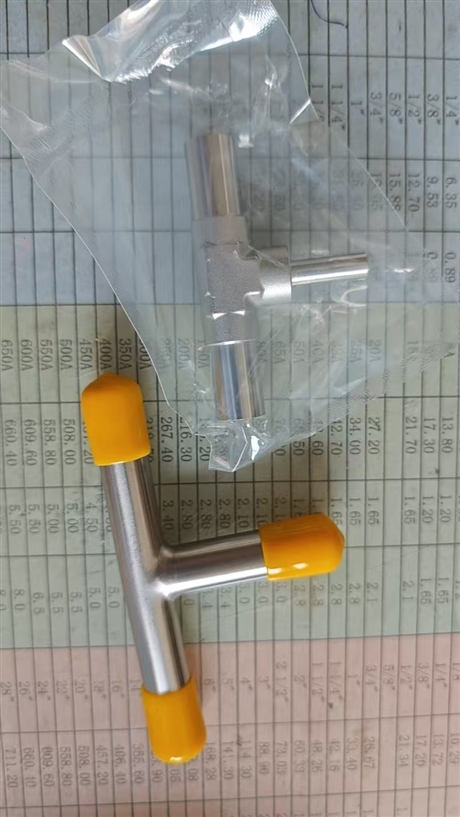

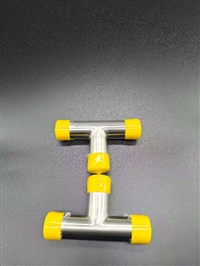
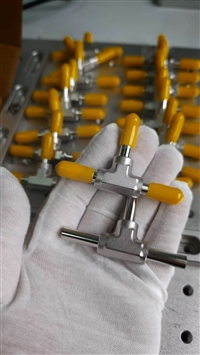
316L BA grade stainless steel three-way high-purity fluid pipeline connector
Category:
hardware/Pipe fittings/Three way and four way
Model:
1/8,1/4, 3/8, 1/2, 5/8, 3/4, 1, 1.25, 1.5, 2, 2.5, 3, 4, 5, 6
Brand:
Mengxuan Fluid
Material:
316L stainless steel
Surface Treatment:
BA Bright Annealing
connection method:
Welding/card sleeve
Execution Standard:
ASTM A270/GB/T 20878
Internal surface roughness:
Ra≤0.4μm
Applicable Medium:
High purity fluids/corrosive chemicals
Operating temperature:
-20 ℃ to+150 ℃
Application Fields:
Semiconductor/Biomedical/Food
Retail Price
10,000,000.00USD
重量
kg
- Product Description
-
Material 316L stainless steel
Surface Treatment BA Bright Annealing
connection method Welding/card sleeve
Execution Standard ASTM A270/GB/T 20878
Internal surface roughness Ra≤0.4μm
Applicable Medium High purity fluids/corrosive chemicals
Operating temperature -20 ℃ to+150 ℃
Application Fields Semiconductor/Biomedical/Food
Description :
316L BA grade stainless steel tee is a key connecting component in high-purity fluid transportation systems, mainly used to achieve pipeline diversion or merging. This category is made of high-quality 316L stainless steel material, which has excellent corrosion resistance and mechanical strength, and is particularly suitable for working environments with extremely high cleanliness requirements such as semiconductors, biomedicine, food and beverage. The BA (Bright Annealed) bright annealing process makes its inner wall smooth and has an extremely low roughness Ra value, effectively preventing medium residue and bacterial growth, ensuring the purity and stability of fluid transmission, and is an ideal choice for building high-purity pipeline systems.
The manufacturing of 316L BA grade stainless steel tees strictly follows relevant industry standards, usually in compliance with specifications such as ASTM A270 or GB/T 20878. The addition of molybdenum element in the material composition significantly enhances its resistance to pitting corrosion and adapts to various chemical media. Surface treatment involves electrolytic polishing or mechanical polishing followed by bright annealing. The inner surface roughness Ra is usually controlled below 0.4 μ m, and the outer surface presents a uniform metallic luster. Precise dimensional tolerance and accurate welding port angle ensure the docking accuracy during automatic track welding. Before leaving the factory, the product needs to undergo strict airtightness testing and visual inspection to ensure that there are no defects such as sand holes or cracks, and to meet the strict requirements of high-purity systems for component consistency.
When selecting 316L BA grade stainless steel tees, special attention should be paid to the outer diameter, wall thickness, and connection methods (such as sleeve type and welding type) of the pipeline. Applicable scenarios include ultra pure water systems, injection water pipelines, special gas transportation, and corrosive chemical pipelines. If the working pressure exceeds the conventional standard or experiences extreme temperature fluctuations, it is necessary to verify the specific pressure rating. Compared with ordinary 304 stainless steel tees, 316L material has better corrosion resistance in chloride ion environments; Compared to non BA surface products, BA surfaces are more conducive to cleaning validation. For ordinary industrial water and gas circuits that do not require high purity, low-cost AP surfaces or ordinary polishing products can be selected to optimize procurement costs.
When installing 316L BA grade stainless steel tees, it is recommended to use an automatic track welding machine for welding to ensure the quality of the weld and the flatness of the inner wall, and to avoid oxidation skin pollution caused by manual welding. In daily maintenance, it is necessary to regularly check whether there are signs of leakage at the connection points, and pay attention to controlling the flow rate and temperature during the system cleaning and disinfection process to prevent water hammer effect from damaging the pipe fittings. Common faults are mostly micro leaks caused by poor welding or localized corrosion caused by surface scratches. If such problems are found, they should be replaced in a timely manner. When storing, the packaging should be kept intact and placed in a dry and ventilated place to avoid mixing with other metals, which may cause iron ion contamination and affect its corrosion resistance.
AfterSalesService :
Key words:
More Products