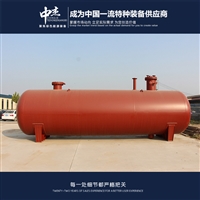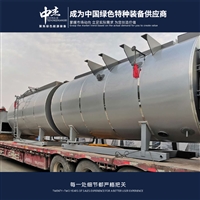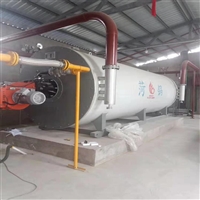



New prices for heat transfer oil boilers in 2020, manufacturers of heat transfer oil boilers
Category:
mechanical equipment/Industrial boilers and accessories/Heat transfer oil boiler
Model:
YYQ700
Brand:
Zhongjie Special Equipment
Retail Price
85,000.00USD
重量
kg
- Product Description
-
Description :
Product Features:
1. Thermal oil boiler is a direct current special boiler developed based on the design thinking of forced circulation.
2. Closed loop heating, connected to the atmosphere, can extend the service life of boilers, transport heat energy in liquid phase, reduce heat loss, achieve significant energy-saving effect, and have good environmental protection effect.
3. The thermal oil boiler adopts a three loop coil design, which determines the safety that traditional boilers do not have due to its direct flow structure.
4. Due to the use of a coil structure, the heating surface is sufficient, resulting in high thermal efficiency.
5. The significant feature of a thermal oil boiler is counterflow heat transfer, with a temperature difference between the combustion exhaust gas and the thermal oil outlet of less than 30 ℃.
6. The structure of a heat transfer oil boiler mainly operates at lower pressures, obtaining working temperatures below 450 ℃, and has the characteristics of low pressure and high temperature.
Thermal oil furnaces are widely used in industries such as petrochemicals, textiles, printing and dyeing, plastics, rubber, food processing, wood processing, asphalt heating, cardboard box production, vegetable dehydration, baking paint, casting sand mold drying, etc.
Thermal oil furnace is the customary term for "organic heat carrier furnace". Thermal oil furnace is a special type of boiler, and its working medium (heat medium) is not water, but thermal oil. The advantage of using thermal oil as the working medium is that it can achieve higher working temperatures at lower working pressures to meet the industrial demand for low-pressure and high-temperature heat sources. For example, if the heat transfer oil can be heated to 300 ℃ at a low pressure of 0.8MPa, the water pressure must also be raised to a high pressure of 9MPa. Similar to general boilers such as steam boilers and hot water boilers, thermal oil boilers are also divided into gas-phase boilers and liquid-phase boilers. Currently, the most commonly used method in China is the liquid-phase thermal oil furnace.
Thermal oil furnaces have low working pressure, high thermal efficiency, convenient manufacturing, and simple operation, making them widely used in various industrial sectors such as petrochemicals, light industry, textiles, food, building materials, and transportation. The heating temperature is approximately between 250 ℃ and 320 ℃. Correspondingly, in order to ensure the safety of the use of heat transfer oil furnaces, China issued the "Safety Technical Supervision Regulations for Organic Heat Carrier Furnaces" 10 years ago. In addition to requiring heat transfer oil furnaces to comply with the corresponding provisions of general boiler safety supervision regulations, special provisions have also been made for the special characteristics of heat transfer oil furnaces.
Thermal oil is divided into two categories: mineral oil type and synthetic type. Currently, most of the thermal oil used in China is mineral oil type. Overall, thermal oil belongs to the lubricant series of petroleum products, with relatively stable chemical properties and is not as prone to ignition and combustion as light oil. From a usage and safety perspective, its main features are:
Within the allowable temperature range, it has good thermal stability, less coking, and a longer service life.
Within the allowable temperature range, the thermal conductivity, flowability, and pumpability are good.
3. Low toxicity, odorless, non corrosive to equipment, and minimal impact on the environment.
4. The freezing point is low, the boiling point is high, and the content of low boiling point components is relatively low. Within the allowable temperature range, the vapor pressure is not high and the evaporation loss is minimal.
When the temperature is above 70 ℃, it will be strongly oxidized when in contact with air. The heated working system needs to be sealed, and it is only allowed to come into contact with air at temperatures below 70 ℃.
After being heated, the volume expands significantly, with an expansion rate much greater than that of water. The temperature rise is 100 ℃, and the volume expansion rate can reach 8% to 10%.
When overheated, cracking or condensation may occur, resulting in coking or carbon deposition in containers and pipelines.
When mixed with water or low boiling point components, the vapor pressure will significantly increase after heating.
9. The flash point, ignition point, and self ignition point are all relatively high, and will not ignite or burn under allowable temperature and sealed conditions.
Structure of thermal oil furnace
The thermal oil furnace is composed of auxiliary equipment accessories inside the pot, and its combustion system is roughly the same as that of a general boiler, with two types of internal system: branch tube type and shell type.
The tube type heat transfer oil furnace is composed of a tube system, and there are two types: coil type and straight tube type. The heat transfer oil furnaces for fuel and gas are mostly coil type, with the central cavity of multiple rows of concentric coils as the combustion chamber, and the annular space between the surrounding pipes as the flue gas channel. Through radiation and convection, the heat from the flue gas is transferred to the heat transfer oil through the pipe wall. Coal fired thermal oil boilers come in both coil and straight tube types, with the latter having a structure similar to that of a pipe rack hot water boiler.
The shell type heat-conducting oil furnace consists of a shell and a pipe system, and its structure is similar to that of a general horizontal water fire tube boiler.
Heating system of thermal oil furnace
The flow and heat exchange system using thermal oil as the medium is a forced flow heat exchange system. The system connects the circulating oil pump, heat transfer oil furnace, heat consuming equipment, separator, and filter into a closed circuit through pipelines. The circulating oil pump drives the heat transfer oil to flow forcibly in the circuit, absorbing heat and increasing temperature in the heat transfer oil furnace, and releasing heat and decreasing temperature in the heat consuming equipment; The system is connected to an expander through a pipeline, which is used for the thermal expansion of the heat transfer oil and the escape of water vapor and light components; At the low end of the system, connect the oil storage tank and the oil injection pump.
AfterSalesService :
Key words:- New prices for heat transfer oil boilers in 2020
More Products