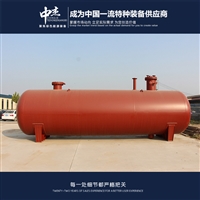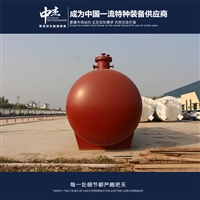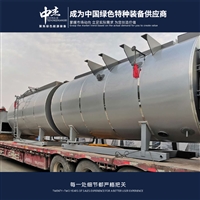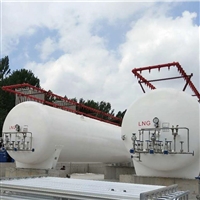
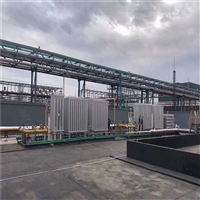
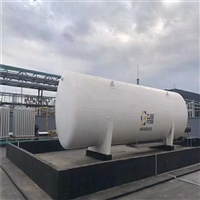
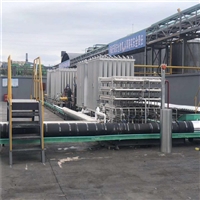
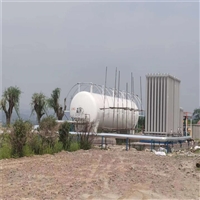


60 cubic meter horizontal natural gas storage tank application 60 cubic meter low-temperature storage tank price
Category:
mechanical equipment/Storage and transportation equipment/storage tank
Model:
CFW60-0.8
Brand:
Zhongjie Special Equipment
Retail Price
292,000.00USD
重量
kg
- Product Description
-
Description :
Technical requirements for industrial pipeline installation
(1) Key points of pipeline installation technology
1. The connection between pipelines and large or moving equipment should use stress free piping, and their fixed welds should be kept away from the machine.
2. Valve installation should comply with regulations
(2) When the valve is connected to the metal pipeline by flange or thread, the valve should be installed in the closed state; When connected by welding, the valve must not be closed, and argon arc welding should be used for the bottom layer of the weld seam.
When non-metallic pipelines are connected by electric melting or hot melting, the valves near the joint should be in the open state.
(3) The installation of safety valves should meet vertical installation requirements.
Installation requirements for thermal pipelines
1. Thermal pipelines are usually laid overhead or in trenches. For the convenience of drainage and air release, the slope should be set during pipeline installation. The slope of indoor pipelines is 0.002, the slope of outdoor pipelines is 0.003, and the slope of steam pipelines should be the same as the flow direction of the medium to avoid noise. Each section of the pipeline should be equipped with a drainage device and a venting device. Thermal pipelines laid together with other pipelines may not have a slope if they provide continuous gas supply year-round or seasonally, but drainage devices should be strengthened. The steam trap should be installed at the following location: the point where condensation water may accumulate in the pipeline The front side of the orifice plate and other areas prone to water accumulation.
When the compensator is installed vertically, if the medium conveyed by the pipeline is hot water A vent valve should be installed at the compensator point, and a drain valve should be installed at the point. If the medium being transported is steam, a steam trap or drain valve should be installed at the compensator point.
3. Fixed brackets should be installed between two compensators (usually 20-40m) and on both sides of each compensator (referring to the far end). The fixed bracket is subjected to significant force and must be securely installed. A guide bracket should be installed in the middle of the two fixed brackets, and the guide bracket should ensure that the pipe can freely expand and contract in the specified direction. The supports on both sides of the compensator should be movable supports, set at a distance of 0.5-1m from the starting point of the compensator bend, and no guide or fixed supports should be set.
4. The bottom of the pipeline should be equipped with a high sliding bracket by spot welding, and the height of the bracket should be slightly greater than the thickness of the insulation layer. When installing the guide brackets on both sides of the bracket, there should be a gap of 3-5 between the groove and the bracket.
5. When installing the guide bracket and the bracket of the movable bracket, it should be considered that the center of the bracket is consistent with the center of the bracket, and the movable bracket should not be offset after thermal expansion. When installing several brackets near the compensator on both sides, eccentricity should be installed, and the length of eccentricity should be half of the thermal extension of the pipeline from the fixed point at that point. The direction of eccentricity should be based on the center of the compensator.
6. Spring brackets are generally installed in areas with vertical expansion and contraction but no horizontal expansion and contraction. During installation, it is necessary to ensure that the spring can expand and contract freely. Spring hangers are generally installed at both horizontal and vertical expansion points with vertical expansion. When installing the hanger, it should be biased towards the opposite side of the expansion direction.

Basic requirements for installation of indoor heating pipes:
(1) The heating pipeline adopts steel pipes that transport low-pressure fluids, namely non galvanized welded steel pipes, or black iron pipes. The installation of pipelines should have a slope. If there are no design requirements, the slope should comply with the following regulations: hot water heating and hot water supply pipelines, as well as steam and condensate pipelines that flow in the same direction as steam and water. In this case, the slope of the pipeline is generally 0.003, but cannot be less than 0.002. For steam and condensate pipelines with reverse flow of steam and water, the slope is generally not less than 0.005.
(2) During the installation of indoor heating pipes, if the pipes pass through doors, windows, or other openings, beams, columns, wall piers, etc., and the corners are higher or lower than the horizontal direction of the pipes, exhaust and drainage devices should be installed at their points or points respectively. The main function of this is to remove air and dirt from the pipes.
(3) When setting up pipelines to pass through floors and walls, iron sheet or steel conduit should be installed.
Material requirements:
1. Pipe materials: carbon steel pipe, seamless steel pipe. The pipe shall not be bent or corroded, and there shall be no burrs, heavy skin, or unevenness.
2. Pipe fittings: No deviation, square buckle, disorderly buckle, broken wire, or inaccurate angle.
3. Valve: Casting rules, punctures, no cracks, flexible and tight opening and closing, no damage to the threads, correct straightness and angle, strength meets requirements, and the handwheel is undamaged. There is a factory certificate of conformity, and strength and tightness tests should be conducted according to relevant regulations before installation.
4. Other materials: section steel, round steel, pipe clamps, bolts, nuts, oil, hemp, pads, electrical welding rods, etc. When selecting, it should meet the design requirements.

Technical requirements for industrial pipeline installation
(1) General provisions
1. Check the quality of each component, promptly handle any non-compliance, and prevent the use of unqualified components in the system.
2. Nylon lifting straps should be used when hoisting stainless steel pipes, and direct hoisting of stainless steel pipe sections with steel wire ropes is prohibited.
3. Connect various components, flanges, and valves, weld them and pass inspection.
4. Valves, instruments, etc. used in pipelines shall undergo strength and sealing tests according to design requirements before installation, and shall be debugged and qualified. Qualified products are strictly prohibited from installation. Products that meet installation requirements should be accompanied by qualified products.
Before installing the pipeline, it should be measured and laid out according to the drawings, and the actual site should be confirmed to be correct with the drawings before installation.
During pipeline installation, it should be carried out according to the pipeline prefabrication section diagram. For those with adjustment sections, measurements should be taken according to the actual site conditions, and the required adjustment size should be cut based on the measured dimensions.
When cutting and chamfering pipe sections, stainless steel pipes should be used with tools and should not be mixed with carbon steel pipes.
Before installing the pipeline section, the cleanliness inside the pipeline should be checked. If dirt is found inside the pipe, it should be blown or cleaned by other methods before assembling and welding the pipe sections.
9. Pipeline installation requires filling out the "Pipeline Construction Inspection Record".

Basic identification colors, identification symbols, and safety signs for industry pipelines
According to the national standard "Basic Identification Colors, Identification Symbols, and Safety Signs for Industrial Pipelines" GB 7231-2003, the basic identification colors, identification symbols, and safety signs for industrial pipelines are specified
1. According to the general properties of substances in pipelines, basic identification colors can be divided into eight categories, such as: water is bright green, water vapor is bright red, air is light gray, gas is medium, acid or alkali is purple, combustible gas is brown, other liquids are black, and oxygen is light blue.
2. The identification symbols for industrial pipelines consist of material names, flow directions, and main process parameters.
AfterSalesService :
Key words:- 60 cubic meter horizontal natural gas storage tank
More Products