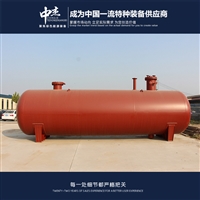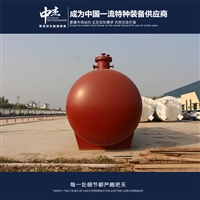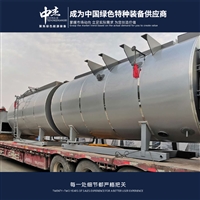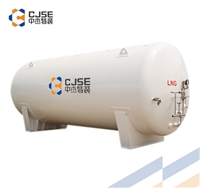
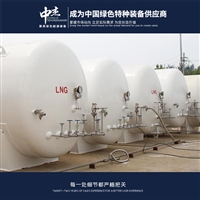
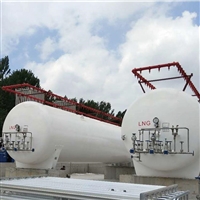
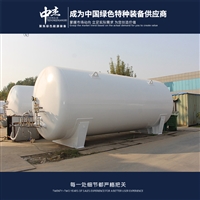
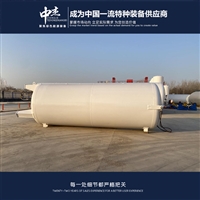
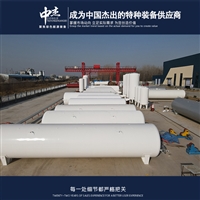
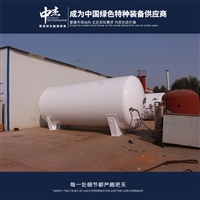
Low temperature storage tank storage and transportation hazards, manufacturer of horizontal 60 cubic LNG storage tank
Category:
mechanical equipment/Storage and transportation equipment/storage tank
Model:
CFW60-0.8
Brand:
Zhongjie Special Equipment
Retail Price
315,000.00USD
重量
kg
- Product Description
-
Description :
(1) What are the requirements for the foundation construction of low-temperature storage tanks
Low temperature storage tank is a type of pressure storage tank, which is particularly suitable as an essential and important basic equipment in industries such as petroleum, chemical, grain and oil, food, fire protection, transportation, metallurgy, etc.
Low temperature storage tanks not only have many precautions in use, but also many issues to pay attention to during installation. The foundation for installing the storage tank is to choose a good foundation for the tank.
For typical foundations, soft soil foundations, mountainous foundations, and land foundations, the corresponding foundation treatment methods should be proposed based on the identified conditions.
The foundation has satisfactory overall stability, uniformity, and planar bending stiffness. The stiffness of the foundation structure directly below the tank wall should be strengthened, and the foundation bed supporting the bottom plate should be flexible to absorb welding deformation. It is recommended to install oil barriers and oil leakage signal pipes, and the distance between the groundwater level and the top surface of the foundation should not be less than the height that capillary water can reach.
The steel structure of the low-temperature storage tank roof should be constructed after the temporary support platform on the tank roof is erected. The center ring of the tank top steel structure should be prefabricated and inspected on the ground. After confirmation of qualification, it should be installed on the center column, and the installation positions of each steel structure skeleton should be marked on the center ring. In order to enhance the stability of the scaffolding, two cranes should be used for symmetrical installation of steel structures in groups. Positioning lines should be drawn on the concrete wall to control the installation position of the steel structure on the top of the tank.
When installing the connecting ring beams of each group of steel structure sub bones, there is no need for positioning plates, and the gap can be directly installed on the main and sub bones. The welding of steel structures should adopt the method of spaced welding. Install sub bones between the welded steel structures, and use positioning plates with a gap of 1-2mm to connect the ring beams between the steel structures. The welding of the steel structures still adopts the method of interval welding.

(2) How to conveniently monitor liquefied gases in low-temperature storage tanks
The constantly increasing budget, problems, and urgent calls to gas suppliers have made the environment of the gas industry more complex than ever before. With the expansion of factories and warehouses, improving efficiency, simplifying management, and balancing budgets have become particularly prominent. In order to change the supply chain, gas suppliers need to conduct real-time analysis of low-temperature storage tanks to understand the demand for refilling and the real-time distribution of liquefied gas.
Disruption of operational efficiency
In times of economic hardship, improving operational efficiency and maintaining health checks on functionality are crucial. The unavailability of low-temperature liquids and emergency transportation of bulk gases are theoretically and literally expensive. The unavailability of low-temperature liquids can affect the revenue of gas companies. The emergency transportation of pressurized low-temperature storage tanks requires separate costs, which increases the expenses of gas companies and reduces budgets.
Technological progress to bridge the monitoring gap
The world has developed, and technology has also advanced. New technologies can monitor infrastructure and tank levels. The technology used by industrial gas cylinder suppliers and gas merchants in the past is now outdated. New technologies and tools can successfully overcome the shortcomings of manual measurement techniques to fill the monitoring gap.
Addressing the availability and transportation issues of liquefied gas
Yu Yun's monitoring system utilizes telemetry technology and sensing equipment to provide a solution for tank level monitoring. The liquefied gas monitoring instrument simplifies the tracking, processing, and real-time monitoring of liquefied gas consumption. It enables gas companies to inspect the condition of liquefied gas storage tanks, as their availability and delivery are crucial and time sensitive.
Change manual mode to automatic mode
The manual reading protocol for recording tank data is an inefficient data collection method. Throughout the day, the available low-temperature pressurized liquefied gas in the tank needs to be monitored. To complete this task, sufficient manpower is needed, and further training and review are required. This process is both time-consuming and expensive.
The wireless tank monitoring system solves these problems through automatic monitoring, reducing human intervention and saving potential costs and valuable time. Not only can it accurately follow the liquid level of the storage tank, but it can also automatically update the system for document work.
Maintaining highly traditional leak detection techniques from every corner has disappointed gas suppliers and created an unfavorable environment for employees and customers. The low-temperature liquefied gas detection system provides a solution for monitoring instantaneous leaks of low-temperature liquefied gases. The temperature drop caused by the leakage of low-temperature fluid gas is detected by the sensing device and an alarm is issued.
AfterSalesService :
Key words:- Hidden dangers in storage and transportation of low-temperature storage tanks
More Products