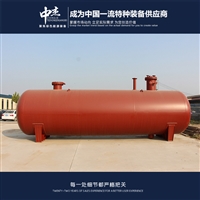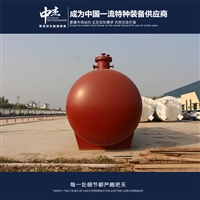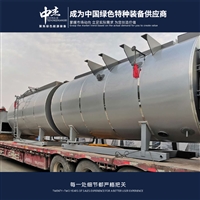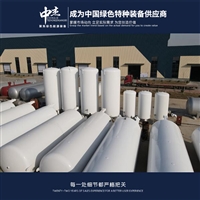
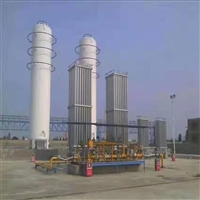
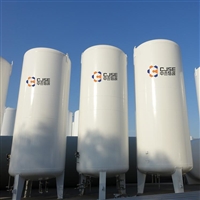
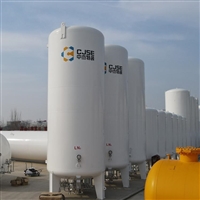
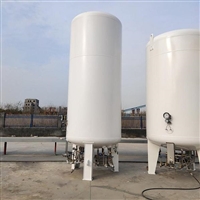

Valve Configuration of Zhongjie Equipment's Low Temperature Carbon Dioxide Storage Tank Listed Company
Category:
mechanical equipment/Storage and transportation equipment/storage tank
Model:
CFL30-1.44
Brand:
Zhongjie Special Equipment
Retail Price
256,000.00USD
重量
kg
- Product Description
-
Description :
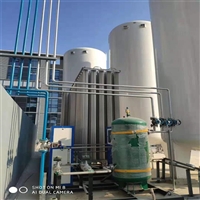
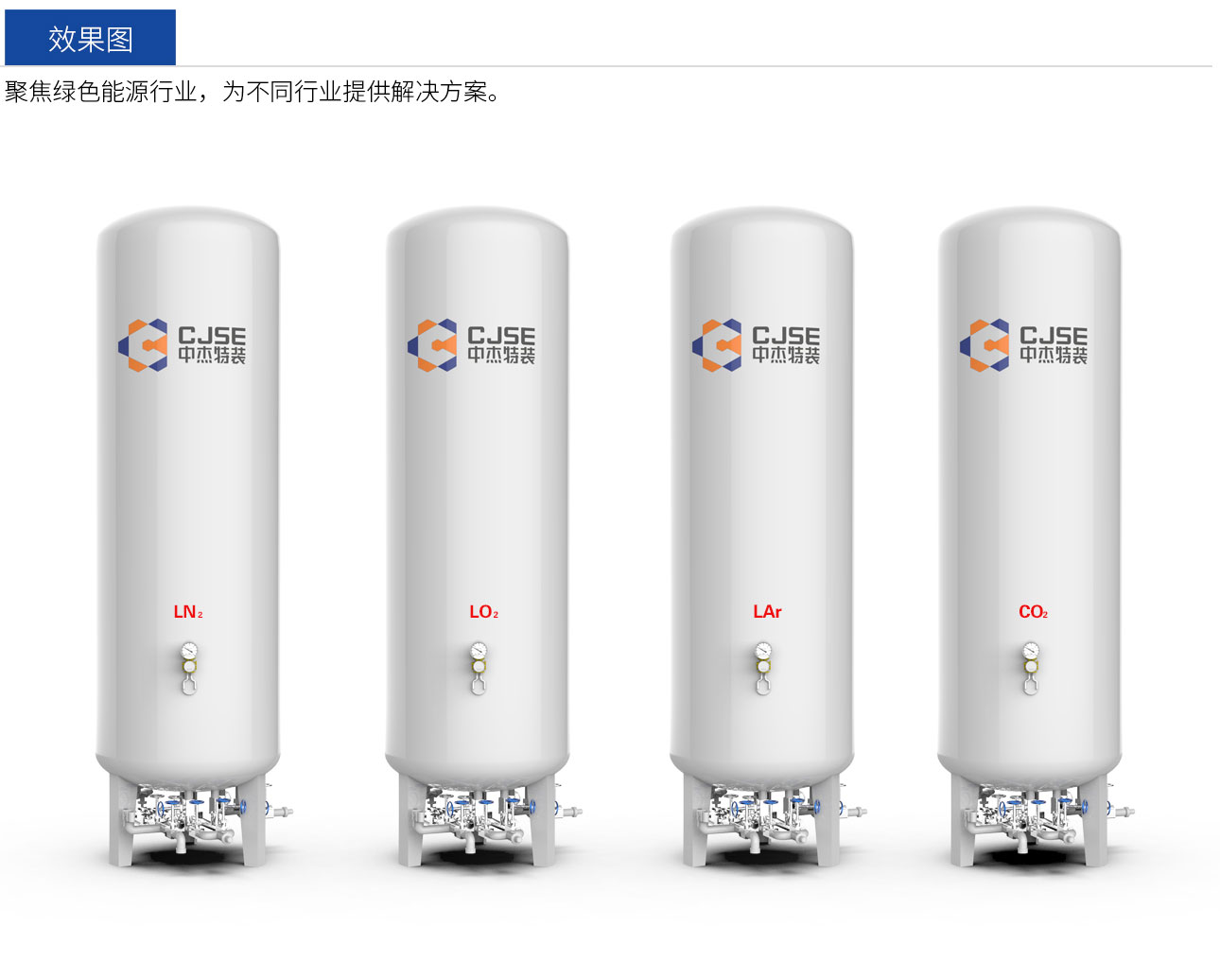
The low-temperature liquid carbon dioxide storage tank adopts a "combination and safety system valve" that uses two sets of safety valves to work simultaneously. During regular calibration of the safety valves, one side can be closed while the other side continues to work, ensuring the safe operation of the storage tank. The upper part of the tank container is set uppressure gaugeDifferential pressure level gauge and level comparison table can monitor the storage capacity and pressure changes of the inner container at any time, making it easy to operate during filling and discharging.
Performance:
1. Adopting double-layer tank body, vacuum powder insulation, complete quality assurance system, strict manufacturing process, imported key components, stable and reliable quality.
2. High quality pearl sand is used for filling, and all welds of the inner and outer containers of the low-temperature storage tank are subjected to helium mass spectrometry leak detection. It has good insulation performance, low evaporation loss, and long service life.
3. High quality epoxy zinc rich primer paint ensures a more beautiful appearance and longer anti-corrosion life of the product.
4. The compact structure of the storage tank, advanced pipeline and process design make operation more simple and safe, maintenance more convenient, and safe and reliable.
5. There are two types: discrete and horizontal. In addition to conventional products, low-temperature liquid storage tanks of various volumes and pressure levels can be designed and manufactured.
Maintenance of Low Temperature Liquid Storage Tank
Common problem analysis and handling: The maintenance of vacuum degree in the interlayer of the storage tank is not only the guarantee of the insulation performance of the storage tank, but also the fundamental guarantee for the normal operation of the storage tank. After the storage tank is put into use, common problems are often related to the degree of vacuum maintenance. There are obvious large areas of sweating and frosting outside the storage tank. It may be caused by pipeline leakage in the storage tank interlayer, unfilled pearl sand, or other reasons leading to the breakdown of the interlayer vacuum degree. This requires inspection and repair, leak detection, or addition of pearl sand, which can be vacuumed again. ⑵ The pressure inside the storage tank rises abnormally, causing the safety valve to trip. It may be caused by the following three reasons: a. The vacuum degree of the storage tank interlayer is damaged; b. The inner cylinder booster valve is malfunctioning and needs to be repaired or replaced; c. The leakage location at the lower part of the interface is at the welding point between the stainless steel and carbon steel shell, or at the connection between the copper pipe and the stainless steel inner cylinder, that is, at the dissimilar welding joint, mainly forming electrochemical corrosion at the dissimilar welding joint. (3) The evaporation rate increases and the vacuum degree decreases. It may be due to the release of air from the pearl sand. Pearlescent sand has certain particle size and temperature requirements during filling. When the particle size and temperature of the pearl sand are not suitable, after running for a period of time, the pearl sand will release water vapor, reducing the vacuum degree and increasing the evaporation rate. (4) The top of the outer cylinder of the storage tank is sweating. It may be caused by the aggregation of pearl sand in the lower part. Due to the sinking of the pearl sand after being put into use for a period of time, a space is formed at the top of the container, and the local insulation effect is significantly reduced, resulting in the container running cold. In this case, if the evaporation rate is high, the top of the jacket outer cylinder can be excavated and pearl sand can be added.
Introduction to vacuum storage tank repair technology (adding pearl sand, pressure testing, vacuum pumping):
1. Firstly, it is crucial to choose a reliable high-performance vacuum pump. We have selected the 2X-70 two-stage rotary vane vacuum pump with a pumping speed of 70 liters per second, which can achieve a vacuum degree of 10-3 Torr (0.133Pa) and has a good performance. To shorten the pumping time, a series pump can be used, that is, an additional Roots post stage pump can be added.
2. The accuracy of vacuum measurement is the key to the success of vacuum pumping. Generally, vacuum gauges are randomly installed on vacuum storage tanks, and the vacuum degree can be directly measured at any time using a thermocouple vacuum gauge. However, due to the high susceptibility of vacuum gauges to contamination, measurement errors are significant. Multiple vacuum storage tanks have been measured using thermocouple vacuum gauges, and most of the measurement values have large deviations and no longer have reference value. The author recommends using a portable rotary caliper vacuum gauge, which is designed according to the Boyle Malott ideal gas constant temperature compression law. Therefore, its scale is calculated based on the instrument, and the measurement reading has "absolute".
AfterSalesService :
Key words:- Low temperature carbon dioxide storage tank
More Products