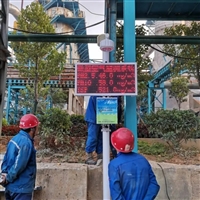

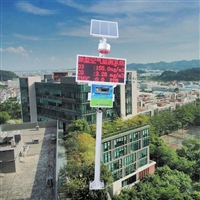
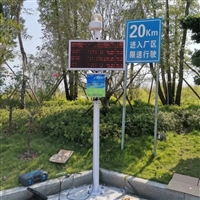
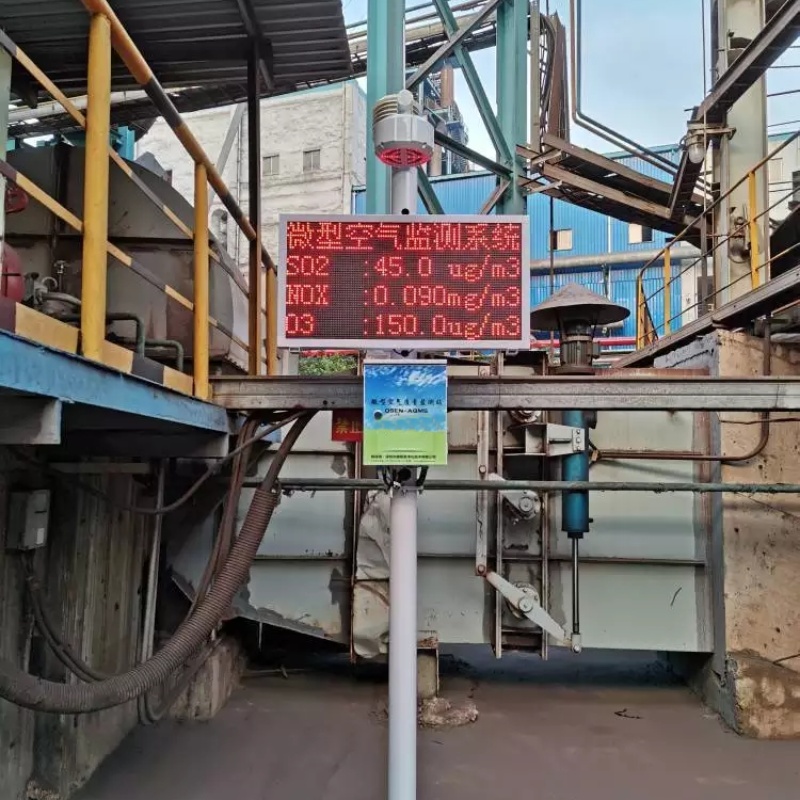
Micro monitoring station with four gases and two dust, CCEP certified micro air station, and micro monitoring equipment
Category:
Environmental Protection/Environmental testing instruments/Environmental detection online system
Model:
BYQL-AQMS
Brand:
Biye Qianli
Item Number:
BYQL
Whether to process customization:
yes
model:
BYQL-AQMS
measurement range:
0-1000
measurement accuracy:
±20%
Place of Origin:
Shenzhen
Scope of Application:
Digital urban management, smart cities, construction sites, garbage dumps, demolition sites, docks, industrial parks, communities, road dust environments, scientific research institutions, and industries in various regions
type:
Vertical pole type
Is it a cross-border source of goods:
No
manufacturer:
Shenzhen Biye Qianli Technology Co., Ltd
Retail Price
15,800.00USD
重量
kg
- Product Description
-
Item Number BYQL
Whether to process customization yes
model BYQL-AQMS
measurement range 0-1000
measurement accuracy ±20%
Place of Origin Shenzhen
Scope of Application Digital urban management, smart cities, construction sites, garbage dumps, demolition sites, docks, industrial parks, communities, road dust environments, scientific research institutions, and industries in various regions
type Vertical pole type
Is it a cross-border source of goods No
manufacturer Shenzhen Biye Qianli Technology Co., Ltd
Description :
The Hunan Smart City Air Environment CCEP Certified Six Parameter Micro Monitoring Station is an environmental monitoring system that integrates data collection, storage, transmission, and management. It can monitor the environment 24/7, continuously, and automatically. Based on the provision of six parameter data such as PM10, PM2.5, SO2, NO2, CO, O3, etc., it can expand the monitoring of various characteristic pollutants such as VOCs, VOCs, VOCs, VOCs, VOCs, VOCs, VOCs, VOCs, VOCs, VOCs, VOCs, VOCs, VOCs, VOCs, VOCs, VOCs, VOCs, VOCs, VOCs, VOCs, VOCs, VOCs, VOCs, VOCs, VOCs, VOCs, VOCs, VOCs, VOCs, VOCs, VOCs, VOCs, VOCs, VOCs, VOCs, VOCs, VOCs, VOCs, VOCs, VOCs. Real time statistics of monitoring equipment data from various factory areas and monitoring points, and analysis and speculation of the overall emission situation in the area based on the environmental conditions and pollution situation of each monitoring point, to achieve overall monitoring of hotspot emission areas, calculation of pollutant diffusion trends, and analysis of emission sources; At the same time, by integrating, sharing, and developing technologies such as the Internet of Things, intelligent collection systems, geographic information systems, and dynamic chart systems, a fully digital, information-based, and intelligent regional environmental online monitoring platform will be established to achieve comprehensive management of controlling unorganized emissions from pollution sources, reducing air pollution, and providing reliable data information and scientific auxiliary management decisions for formulating energy-saving and emission reduction plans; Provide detailed data and scientific basis for the department's environmental decision-making, environmental management, and pollution control.
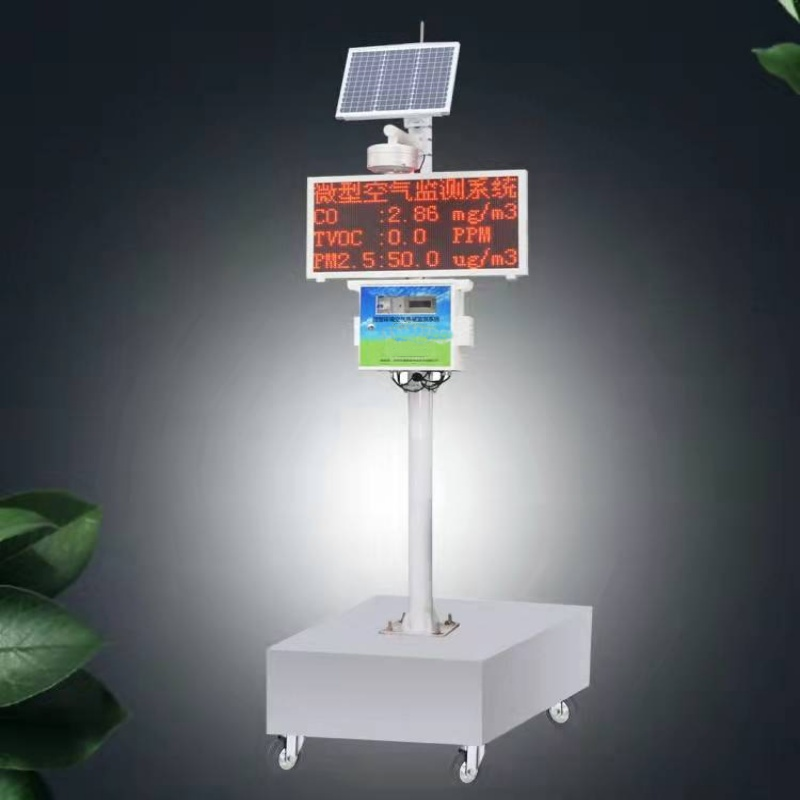
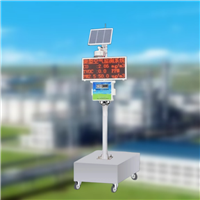
1. The appearance of the monitoring sticker is beautiful and elegant, powered by 220V or solar energy system, and equipped with LED display screen for clear display. The monitoring data is updated and displayed in real-time on site.
2. PM2.5 and PM10 sensors use laser scattering technology for measurement, and screen the data through dual frequency acquisition technology to obtain the number of particles with equivalent particle size per unit volume. The mass concentration of particles with equivalent particle size per unit volume is calculated using scientific algorithms.
3. The monitoring of SO2, NO2, CO, O3, and TVOC in the air is carried out using imported electrochemical sensing modules and our compensation algorithm, which can calculate the real-time concentration of the five gases. It has the characteristics of long life, high accuracy, high repeatability, and high stability.
4. Adopting integrated design and modular combination, all parameters are simultaneously output through GPRS/4G wireless communication or RS485 wired communication.
5. Lifting and alarm function * * *: Sensor lifting function, over concentration alarm function, over temperature and humidity alarm function, fault alarm function, calibration reminder function, etc.
6. The monitoring factors can be freely expanded and combined according to customer needs, with multiple choices and flexibility.
7. Easy maintenance, automatic cloud push program upgrades, reducing operation and maintenance work.
8. Zero point automatic correction: For certain environmental applications, zero point automatic correction function can be achieved.

AfterSalesService :
Key words:- Micro monitoring station
More Products