

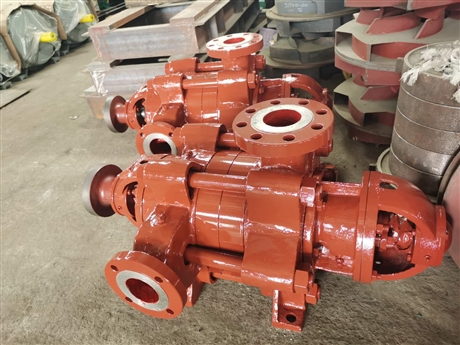

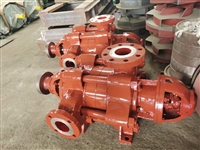


D horizontal centrifugal pump 85-45 * 9
Category:
chemical industry/pump/centrifugal pump
Model:
D580-70X8
Brand:
Zhongda Pump Industry
Retail Price
25,600.00USD
重量
kg
- Product Description
-
Description :
Product Description
The D (DF/DY/MD) series pump is a horizontal single suction multi-stage segmented centrifugal pump, which has the advantages of high efficiency, wide performance range, safe and balanced operation, low noise, long service life, and easy installation and maintenance.
It can be used to transport water without solid particles (abrasives), suspended solids, or other liquids with physical and chemical properties similar to water. It can also be used to transport hot water, oil, corrosive or erosive media by changing the material of the pump (or the material of the pump's overcurrent part), sealing form, and adding a cooling system.
Horizontal multi-stage centrifugal pumps are mainly divided into the following types according to their usage scope:
D-type: Used for conveying clear water or liquids with physical and chemical properties similar to clear water that do not contain solid particles and have a temperature below 80 ℃. Suitable for use in mining factories and urban water supply and drainage engineering.
DF type: Used for conveying corrosive liquids without solid particles and at temperatures ranging from -20 ℃ to 105 ℃. The allowable inlet pressure of the pump is less than 0.4MPa. Users can choose the material and sealing form of the pump according to the name, concentration, specific gravity, operating temperature, and inlet pressure of the conveying medium.
DY type: used for conveying neutral mine water and similar other media with solid particle content<=15%, particle size<=0.5mm, temperature<=80 ℃.
Performance Range
Flow rate: Q=3.75~850m3/h
Lift: H=49-1740m
D/DF/DY/MD pumps have the same performance parameters and installation dimensions.
Model Description
Example: D (DF/DY/MD) 46-30X4
D-multi-stage centrifugal pump
DF multi-stage and corrosive centrifugal pump
DY multi-stage centrifugal oil pump
MD multi-stage grinding centrifugal pump
46- Design point flow rate of 46m3/h
30- Design point lift of 30m
4- Level 4
Example: 100D (DF/DY/MD) 16X3
100- The diameter of the pump suction port is 100mm
D - Multi stage centrifugal oil pump
DF multi-stage corrosion-resistant centrifugal pump
DY multi-stage centrifugal oil pump
MD multi-stage wear-resistant centrifugal pump
30- Design point lift of 30m
4- Level 4
Product Features
1. The hydraulic model is advanced, efficient, and has a wide range of performance.
2. The pump runs smoothly with low noise.
3. The shaft seal adopts soft packing seal or mechanical seal, which is safe, reliable, structurally simple, and easy to maintain.
4. The shaft is a fully sealed structure, ensuring no contact with the medium, no corrosion, and a long service life.
installation sequence
(1) The unit has been transported to the site, and the motor with the base has been installed. When finding the flat base, there is no need to remove the water pump and motor.
(2) Place the base on the foundation, place wedge-shaped shims near the anchor screws, raise the base by 20-40 millimeters, and prepare to level it before filling it with cement slurry.
(3) Use a spirit level to check the levelness of the base. After leveling, tighten the foot nut and fill the base with cement slurry. After the cement dries up, check the levelness again.
(4) When the power of the unit is high, in order to facilitate transportation, the pump, motor, and base may be packaged separately. At this time, the user needs to install and calibrate the water pump unit by themselves, using methods such as washing:
a. Clean the dirt on the support plane of the base, the water pump foot, and the motor foot plane, and place the water pump and motor on the base.
b. Adjust the pump shaft level and tighten the nut appropriately after leveling to prevent movement
c. Lift the motor, align the pump coupling with the motor coupling, and lower the motor to the corresponding position;
d. Adjust the gap between the two couplings to about 5mm, and calibrate whether the axis lines of the motor shaft and the pump shaft coincide. The method is to place a ruler on the coupling, and the outer circles of the two couplings should be level with the ruler. If they do not coincide, adjust the relative position of the motor or pump, or use a thin sheet to adjust;
e. In order to check the accuracy of installation, a feeler gauge should be used to measure the gap between the two coupling planes at several different positions on the circumference of the coupling. The gap difference on the coupling plane should not exceed 0.3 millimeters per week. The difference between the center lines of the two ends, vertically or horizontally, should not exceed 0.1 millimeters.
(5) When the unit does not come with a base, it needs to be installed directly on the foundation using a method similar to 4, but more attention should be paid to calibration.
Installation Notes
1. The weight of the pipeline should not be borne on the pump during installation, otherwise it is easy to damage the water pump;
2. During installation, the anchor bolts must be tightened, and the pump should be checked at regular intervals to prevent loosening, in order to avoid severe vibration during pump start-up that may affect pump performance;
3. Before installing the water pump, carefully check whether there are any hard objects (such as stones, iron sand, etc.) in the pump channel that affect the operation of the water pump to avoid damaging the overcurrent components during the operation of the water pump
4. In order to maintain convenience and ensure safe use, a regulating valve should be installed on the inlet and outlet pipelines of the pump, and a pressure gauge should be installed near the inlet and outlet of the pump. For high lift pumps, to prevent water hammer, a check valve should also be installed in front of the outlet gate valve to cope with accidents such as sudden power outages and loss of power, thereby ensuring that the pump operates under suitable conditions and extending its service life;
5. Pumps used in suction applications should be equipped with bottom valves, and the inlet pipeline should not have too many bends. At the same time, there should be no water or air leakage to avoid affecting the suction performance of the pump;
6. To prevent impurities from entering the pump and blocking the flow path, a filter should be installed in front of the pump inlet to improve performance;
7. Before installing the pipeline, the rotor components of the water pump should be rotated without friction or jamming, otherwise the pump should be disassembled to check the cause.
maintenance
Pump start-up, operation, shutdown, maintenance and upkeep
1. Clean the area around the pump thoroughly.
2. Add calcium based butter into the bearing. The rotor should be flexible and free of jamming when manually operated.
3. Try turning on the motor and check if the motor direction matches the pump.
4. Open the vent valve at the outlet flange and inject water into the pump, or use a vacuum pump to divert water.
5. Close the gate valve and pressure gauge plug on the discharge pipe.
6. After the above work is completed, start the motor and open the pressure gauge plug.
7. When the pump rotates at normal speed and the pressure gauge displays the pressure, open the vacuum gauge plug and gradually open the outlet gate valve until the desired pressure is reached.
8. During operation, the bearing temperature of the pump shall not exceed 35 ℃ of the external temperature, and its maximum temperature shall not exceed 75 ℃. Every 500 hours of operation, grease needs to be injected into the bearings.
9. The normal water leakage level inside the packing room or sealed room should be 30-60 drops per minute, and the tightness of the packing gland or mechanical seal gland should be adjusted at any time.
10. Regularly inspect the coupling and pay attention to the temperature rise of the bearings.
11. When the pump stops, the gate valve on the outlet pipeline should be closed and the vacuum gauge plug should be closed; And stop the motor, then close the pressure gauge plug.
12. When abnormal noise is found during the rotation of the pump, it should be stopped immediately to check the cause.
13. In the cold winter season, if the water pump is temporarily stopped, the square screw on the inlet section must be unscrewed. Drain the stored water to prevent the water pump from freezing and cracking.
14. After long-term use, if there is a significant decrease in flow and pressure of the pump, the pump should be disassembled for inspection and its vulnerable parts should be replaced.
When the water pump is not used for a long time, it should be disassembled, the water in the pump parts should be wiped dry, rust should be removed, and rust proof grease should be applied. Then, it should be reinstalled and stored properly.
AfterSalesService :
Key words:- Horizontal Centrifugal Pump


