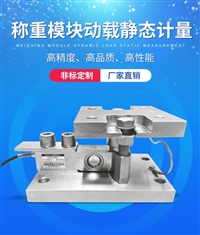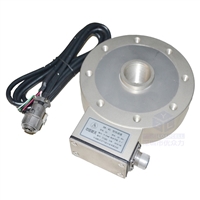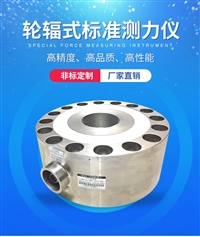


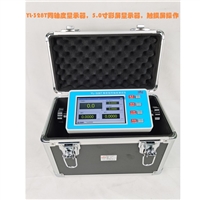
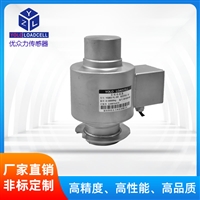
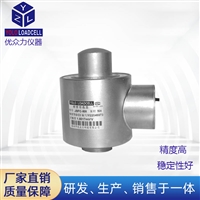
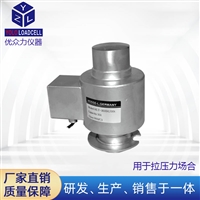

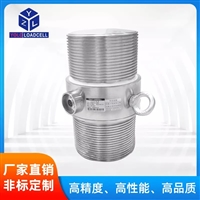
650 ton quantitative force sensor bridge detection standard force gauge 6500kN high-precision sensor
Category:
electron/Sensors, sensitive components/force sensor
Model:
650 ton quantitative force sensor bridge detection standard force gauge 6500kN
Brand:
Youzhongli
Retail Price
30.00USD
重量
kg
- Product Description
-
Description :
650 ton quantitative force sensor bridge detection standard force gauge 6500kN high-precision sensor introduction:
Accuracy selection meets the following two conditions:
1. Meet the requirements for instrument input. The output signal of the sensor must be greater than or equal to the input signal required by the instrument.
2. Meet the accuracy requirements of the entire electronic scale. An electronic scale is mainly composed of three parts: the scale body, sensors, and instruments. When selecting the accuracy of the sensors, the accuracy of the sensors should be slightly higher than the theoretical calculated value.
A weighing sensor is actually a device that converts a mass signal into a measurable electrical signal output. When using sensors, it is important to consider the actual working environment in which the sensor is located. This is crucial for the correct selection of weighing sensors, as it affects whether the sensor can work properly, its safety and service life, and even the reliability and safety of the entire weighing apparatus. [1] There are qualitative differences between the new and old national standards in the basic concepts and evaluation methods of the main technical indicators of weighing sensors.
Traditionally, load sensors are a collective term for weighing sensors and force sensors, and their metrological characteristics are evaluated using a single parameter. The old national standard combines the two types of sensors, "weighing" and "force measuring", which have completely different application objects and environmental conditions, without distinguishing between testing and evaluation methods. The old national standard has a total of 21 indicators, all of which are tested at room temperature; And the accuracy level of the weighing sensor is determined by using the errors in six indicators: nonlinearity, hysteresis error, repeatability error, creep, zero temperature additional error, and rated output temperature additional error, represented as 0.02, 0.03, 0.05... 1.0, respectively.
A force sensor used on a weighing apparatus. It can convert the gravity acting on the measured object into a measurable output signal in a certain proportion. Considering the influence of gravity acceleration and air buoyancy on conversion in different usage locations, the performance indicators of weighing sensors mainly include linear error, hysteresis error, repeatability error, creep, zero temperature characteristics, and sensitivity temperature characteristics. In various weighing instruments and quality measurement systems, the comprehensive error is usually used to control the accuracy of the sensor, and the comprehensive error band is linked to the weighing instrument error band (Figure 1) in order to select the weighing sensor corresponding to a certain accuracy weighing instrument. The International Organization for Legal Metrology (OIML) stipulates that the error band δ of sensors accounts for 70% of the error band Δ of weighing instruments. The sum of linear error, hysteresis error, and error caused by the influence of temperature on sensitivity within the specified temperature range of weighing sensors cannot exceed the error band δ. This allows manufacturers to adjust the various components that make up the total measurement error in order to achieve the desired accuracy.
[2] Weighing sensors can be classified into 8 types based on conversion methods, including photoelectric, hydraulic, electromagnetic, capacitive, magnetic pole transformation, vibration, gyroscope, and cathode strain gauges. Among them, resistance strain gauges are widely used.
Optoelectronic sensors include two types: grating type and encoder type.
The grating sensor utilizes the Moir é fringes formed by the grating to convert angular displacement into photoelectric signals (Figure 2). There are two gratings, one is a fixed grating and the other is a moving grating mounted on the dial axis. The measured object added to the load-bearing platform rotates the dial axis through a force transmission lever system, driving the moving grating to rotate and causing the Moir é fringes to also move. By using phototubes, conversion circuits, and display instruments, the number of Moir é fringes that have passed can be calculated, and the size of the grating rotation angle can be measured to determine and read the mass of the object being measured.
The code wheel (symbol plate) of the code wheel sensor (Figure 3) is a transparent glass mounted on the dial shaft, with black and white codes encoded according to a certain coding method. When the measured object added to the load-bearing platform rotates the dial shaft through a force transmission lever, the code wheel also rotates a certain angle. The photovoltaic cell will receive light signals through the encoder and convert them into electrical signals, which will then be digitally processed by the circuit and displayed on the monitor as numbers representing the measured quality. Optoelectronic sensors were mainly used in electromechanical scales.
The hydraulic sensor, as shown in Figure 4, increases the pressure of the hydraulic oil when subjected to the gravity P of the measured object, and the degree of increase is proportional to P. By measuring the increase in pressure, the mass of the object being measured can be determined. Hydraulic sensors have a simple and sturdy structure, a large measurement range, but the accuracy generally does not exceed 1/100.
The electromagnetic force sensor works based on the principle of balancing the load on the load-bearing platform with the electromagnetic force (Figure 5). When the tested object is placed on the load-bearing platform, one end of the lever tilts upwards; The photoelectric component detects the tilt signal, which is amplified and flows into the coil to generate electromagnetic force, restoring the lever to a balanced state. The mass of the measured object can be determined by digital conversion of the current that generates electromagnetic balance force. Electromagnetic force sensors have high accuracy, reaching 1/2000 to 1/60000, but the weighing range is only between tens of milligrams and 10 kilograms.
The capacitive sensor operates by utilizing the proportional relationship between the oscillation frequency f of the capacitor oscillation circuit and the electrode spacing d (Figure 6). There are two plates, one fixed and the other movable. When loading the tested object on the load-bearing platform, the plate spring bends, the distance between the two plates changes, and the oscillation frequency of the circuit also changes accordingly. By measuring the change in frequency, the mass of the object being measured on the load-bearing platform can be determined. Capacitive sensors have low power consumption, low cost, and accuracy ranging from 1/200 to 1/500.
As shown in Figure 7, when the ferromagnetic element undergoes mechanical deformation under the gravity of the measured object, internal stress is generated and magnetic permeability changes, causing the induced voltage of the secondary coils wound on both sides of the ferromagnetic element (magnetic pole) to also change accordingly. By measuring the change in voltage, the force applied to the magnetic pole can be determined, thereby determining the mass of the object being measured. The accuracy of magnetic pole transformation sensors is not high, usually 1/100, and is suitable for large tonnage weighing work, with a weighing range of tens of thousands to tens of thousands of kilograms.
After the elastic element of the vibration sensor is subjected to force, its natural vibration frequency is proportional to the square root of the applied force. By measuring the change in natural frequency, the force exerted by the measured object on the elastic element can be determined, and then its mass can be determined. There are two types of vibration sensors: vibrating wire type and tuning fork type.
The elastic element of the vibrating wire sensor (Figure 8) is a string wire. When the tested object is added to the load-bearing platform, the intersection point of the V-shaped string is pulled downwards, and the tension of the left string increases while the tension of the right string decreases. The natural frequencies of two strings undergo different changes. By calculating the difference in frequency between two strings, the mass of the object being measured can be determined. The accuracy of vibrating wire sensors is relatively high, reaching 1/1000 to 1/10000, with a weighing range of 100 grams to several hundred kilograms. However, the structure is complex, the processing difficulty is high, and the cost is high.
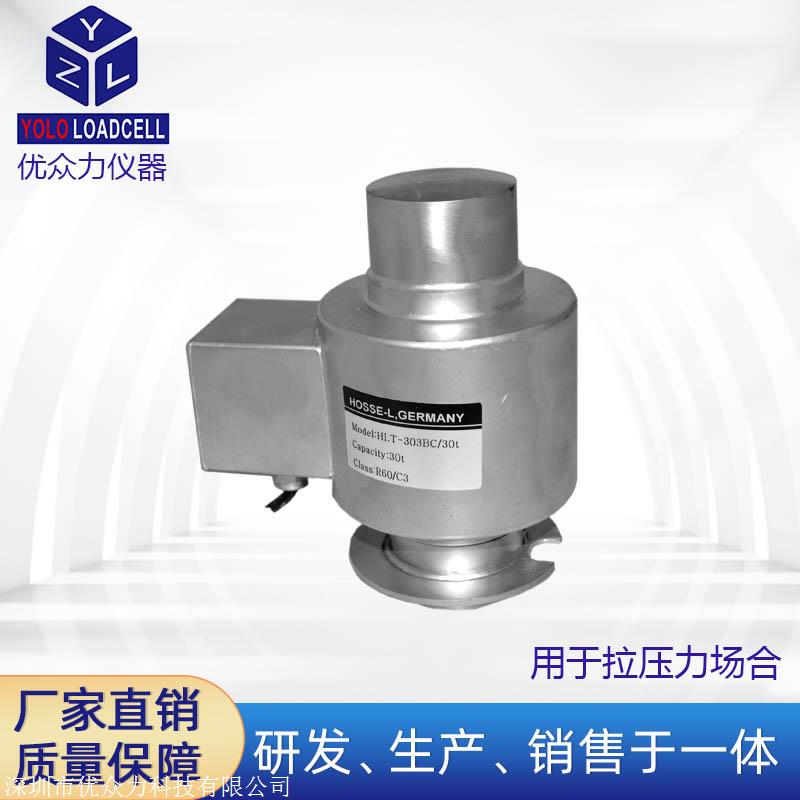

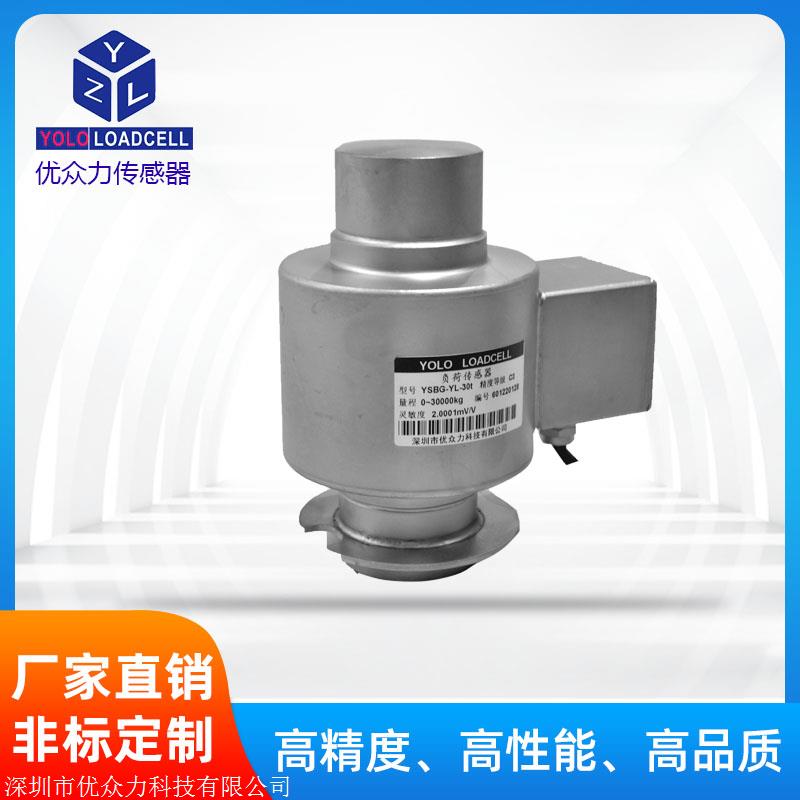
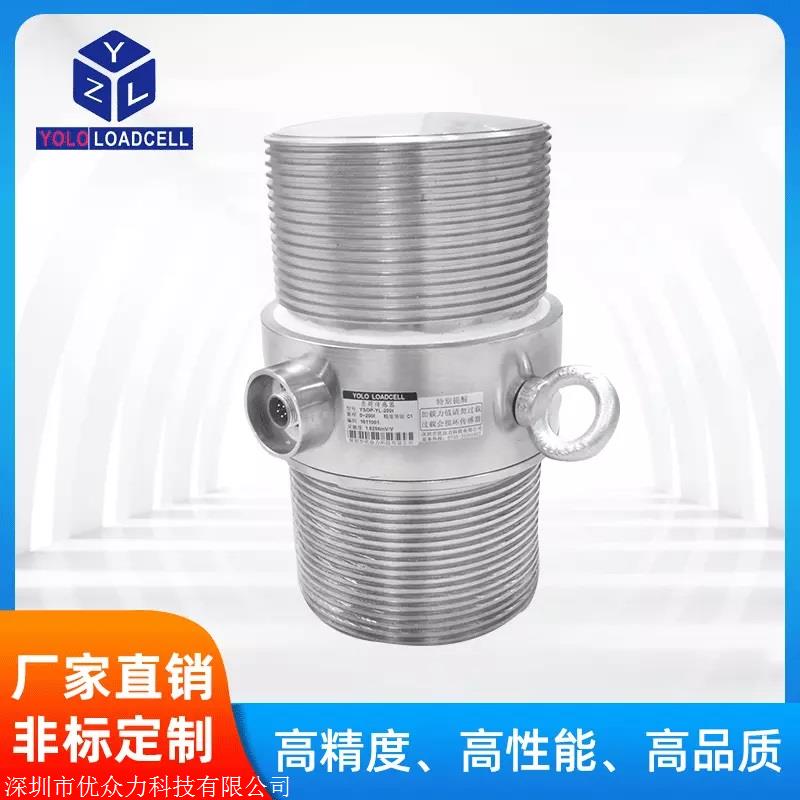

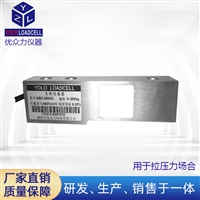
YOLO-LOADCELL, a brand of Youzhongli, produces weighing sensors and various weighing modules that can be used for single item weighing, ingredient system weighing control, and can output communication and analog signal connection control systems. It has high accuracy (0.05%~0.1%) and good stability (annual stability of 0.03%). Aluminum alloy material, alloy steel material, stainless steel material, explosion-proof type, etc. can be selected according to the on-site environment. Force sensor, used for various small space force measurement, large hydraulic equipment force measurement, tension and pressure calibration measurement, can be matched with various digital displays, tension and pressure controllers, and standard force measuring instruments.
AfterSalesService :
Key words:- 650 ton quantitative force sensor