

GLH200 Hydrogen Sulfide Sensor Working Principle of GLH200 Hydrogen Sulfide Sensor
Category:
Instrumentation/Environmental testing instruments/Other environmental testing instruments
Model:
GLH200 Hydrogen Sulfide Sensor
Brand:
middling coal
Retail Price
1,600.00USD
重量
kg
- Product Description
-
Description :


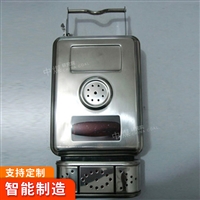
The GLH200 mining hydrogen sulfide sensor is a specialized instrument developed to monitor changes in hydrogen sulfide content in mines. The sensor can automatically convert hydrogen sulfide in mines into standard electrical signals and transmit them to associated equipment. It has on-site display of hydrogen sulfide content value, over limit sound and light alarm, and power-off function.
Scope of application of GLH200 hydrogen sulfide sensor
The GLH200 mining hydrogen sulfide sensor is mainly used for monitoring hydrogen sulfide underground in coal mines, and is suitable for places where hydrogen sulfide detection is necessary, such as underground tunnels, working face gas drainage pipelines, etc.
Explosion proof form: mining intrinsic safety type;
Explosion proof mark: Exib I
The working principle of GLH200 hydrogen sulfide sensor is that the GLH200 hydrogen sulfide sensor adopts an electrochemical H2S sensitive component. In actual measurement, when the sensitive component comes into contact with H2S gas diffusing in the environment, it diffuses through the filter dust cover and the H2S sensitive component permeable membrane into the electrode with a constant potential, and undergoes anodic oxidation reaction with water in the electrolyte under the action of the electrode catalyst. The electrons released on the working electrode generate a current proportional to the concentration of H2S, which is temperature compensated by the detection circuit and converted by an A/D converter before entering the microcontroller for processing into a frequency (current) signal that is linearly consistent with the measured hydrogen sulfide value and sent to the underground system substation. At the same time, the local hydrogen sulfide digital display is achieved. The hydrogen sulfide signal delivered to the substation is sent to the ground control center station through communication interface devices and cables, achieving continuous real-time monitoring of hydrogen sulfide underground. GLH200 Hydrogen Sulfide Sensor Parameters
Working voltage: (9-24.5) VDC;
Rated working voltage: 18.5 VDC;
Working current: ≤ 80 mA (at rated working voltage);
Output signal format: frequency type (200-1000) Hz (pulse width greater than 0.3 ms);
Measurement range 1 × 10⁻⁶ H2S
Basic error, 1 × 10⁻⁶ H2S
Relative error 0-100 ± 5
Transmission distance: 2 km;
Response time: no more than 50 seconds;
Alarm function: The sound pressure level of the alarm signal at a distance of 1m should not be less than 80dB (A);
The light signal should be clearly visible at a distance of 20m in the dark;
Explosion proof type: Exibd Ⅰ mining intrinsic safety and explosion-proof type.
zmjt063


AfterSalesService :
Key words:- GLH200 Hydrogen Sulfide Sensor
More Products