

Working principle of pressure gauge
Category:
Instrumentation/Environmental testing instruments/Other environmental testing instruments
Model:
pressure gauge
Brand:
middling coal
Retail Price
1,600.00USD
重量
kg
- Product Description
-
Description :


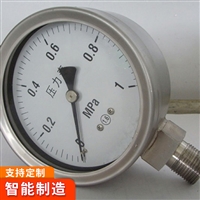
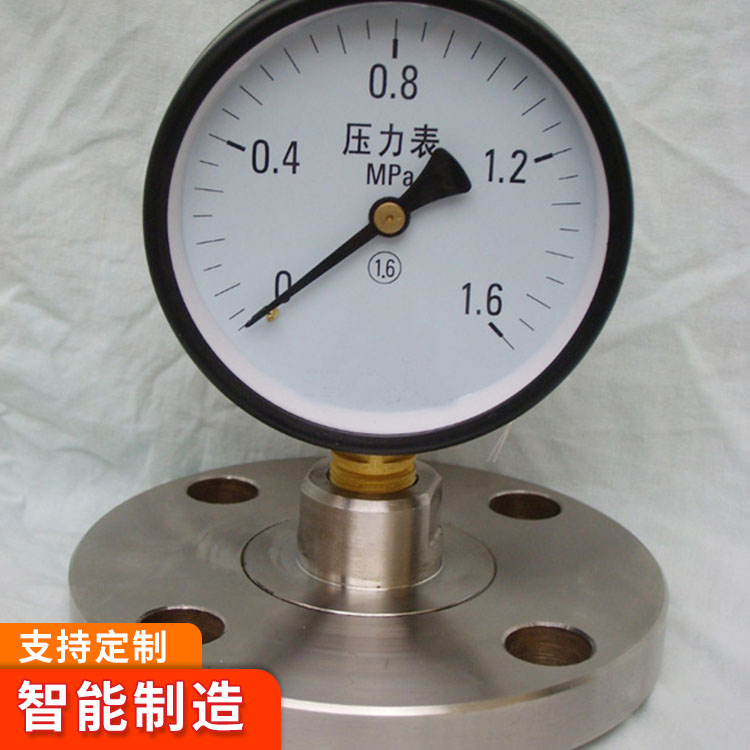
Introduction to Pressure Gauge: A pressure gauge refers to an instrument that uses elastic elements as sensitive components to measure and indicate pressures higher than the ambient pressure. It is widely used in almost all industrial processes and scientific research fields. It can be seen everywhere in fields such as thermal pipelines, oil and gas transmission, water and gas supply systems, vehicle maintenance and repair shops, etc. Especially in industrial process control and technical measurement processes, the elastic sensitive components of mechanical pressure gauges have high mechanical strength and convenient production characteristics, making them increasingly widely used.
The working principle of a pressure gauge is that the pressure gauge transmits the elastic deformation of the sensitive components (Bourdon tube, bellows, bellows) inside the gauge, and then the conversion mechanism of the movement inside the gauge transmits the pressure deformation to the pointer, causing the pointer to rotate to display the pressure.
The pressure gauge mainly constructs an overflow hole: in the event of an emergency situation such as a Bourdon tube bursting, the internal pressure will be released to the outside through the overflow hole to prevent the glass panel from bursting.
Note: In order to maintain the normal performance of the overflow hole, a space of at least 10mm should be left behind the table, and the overflow hole cannot be modified or plugged.
Pointer: In addition to standard pointers, other pointers are also optional.
Glass panel: In addition to standard glass, other special materials such as reinforced glass and non reflective glass are also optional.
Performance classification: Ordinary type (standard), Steam ordinary type (M), Heat resistant type (H), Vibration resistant type (V), Steam vibration resistant type (MV), Heat resistant and Vibration resistant type (HV).
Treatment method: Oil/water prohibition treatment is used to remove residual water or oil in the liquid contact area during manufacturing.
Exterior: The color of the shell should be specially specified in addition to the standard color.
Throttle valve (optional): To reduce pulsating pressure, the throttle valve is installed at the pressure inlet.
Common types of pressure gauges
Bourdon tube pressure gauge, bellows pressure gauge, explosion-proof pressure gauge (classified by performance: electric contact explosion-proof pressure gauge, pointer explosion-proof pressure gauge, digital display explosion-proof pressure gauge), explosion-proof electric contact pressure gauge, explosion-proof digital (pointer) display pressure gauge, vacuum pressure gauge (shock resistant vacuum pressure gauge, electric contact vacuum pressure gauge, stainless steel pressure vacuum gauge, acid resistant pressure vacuum gauge, etc.), etc.
zmjt063



AfterSalesService :
Key words:- pressure gauge
More Products