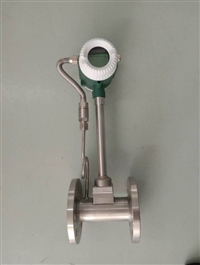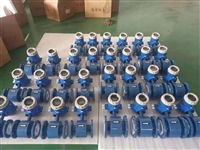
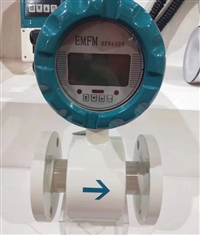
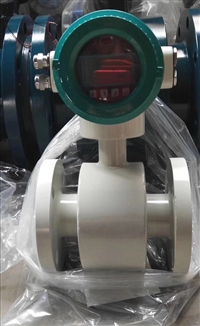
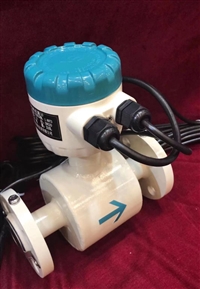
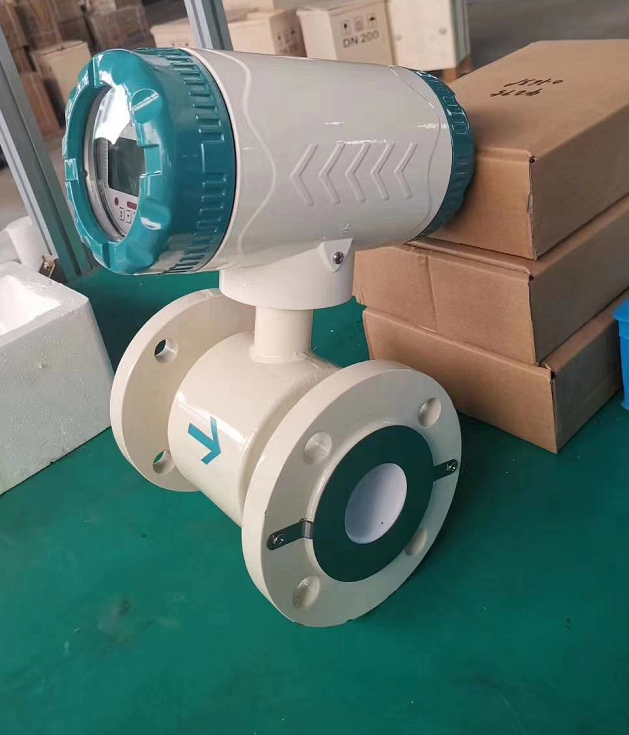
Carbon steel DN800 electromagnetic flowmeter DN800 large-diameter electromagnetic flowmeter
Category:
Instrumentation/Flow meter/electromagnetic flowmeter
Model:
LDE-800
Brand:
Jiangsu Fenghui Instrument Co., Ltd
Retail Price
8,300.00USD
重量
kg
- Product Description
-
Description :
This product adopts a standard RS-485 serial interface, supports the international standard MODBUS-RTU communication protocol, and supports standard analog signal output and cumulative pulse equivalent output.
1、 Characteristics:
The sensor is equipped with a grounding electrode to achieve good grounding of the instrument.
The measuring tube has unobstructed moving parts, no pressure loss, and low requirements for straight pipe sections.
The sensor adopts advanced processing technology, which enables the instrument to have good anti negative pressure capability.
The measurement accuracy is not affected by changes in fluid density, viscosity, humidity, pressure, and conductivity.
The intelligent converter can simultaneously display measurement data such as flow percentage, instantaneous flow, and cumulative flow.
The intelligent converter adopts a liquid crystal backlit LCD display, which can read clearly even in strong light or at night.
The sensor is manufactured using F46 lining proprietary technology and special processes, specifically designed for use in petroleum, chemical, and water pump measurement
Parameters can be set through infrared touch buttons, and can be safely set without opening the cover of the converter in harsh environments.
2、 Technical parameters:
Accuracy level: ± 0.5% R (0.5 ‰)
[nominal pressure]:
1.6MPa(DN10~DN150)
4.0MPa(DN200~DN600)
1.0MPa(DN700~DN1200)
0.6MPa(DN1400~DN2000)
【 Installation Method 】: Flange installation (default), flange reinforcement (customized), clamp installation (customized)
[Electrode type]:
316L electrode
HB/HC alloy electrode (strong acid-base environment);
Titanium electrode; Tantalum electrode; Tungsten carbide electrode; Platinum electrode
[Lining Material]:
Rubber filter (CR);
Polytetrafluoroethylene (F4);
Polyurethane rubber (PU);
[Working environment]: Sensor: -25~180 ℃; Converter: -10~60 ℃
[Fluid Requirements]: Conductive medium (conductivity ≥ 5us/CM liquid)

3、 Installation:
1. Horizontal and vertical installation
Sensors can be installed horizontally and vertically, but it should be ensured to avoid the influence of sediment and bubbles on the measuring electrode, and the electrode axis should be kept horizontal. When installed vertically, the fluid should flow from bottom to top.
2. Ensure full pipe installation
Ensure that the flow sensor is filled with the measured fluid in the pipeline during measurement and that there is no non full pipe state. If the pipeline is not full or the outlet is empty, the sensor should be installed on a siphon tube.
3. Installation between bends, valves, and pumps
To ensure the stability of the measurement, a straight pipe section should be installed in front and behind the sensor, with its length given in the following figure. If it cannot be achieved, a current stabilizer should be used or the cross-sectional area of the measurement point should be reduced.
4. Sensors cannot be installed at the inlet of the pump
To avoid negative pressure, the sensor should not be installed at the inlet of the pump, but at the outlet of the pump.
5. Inlet and outlet straight pipe sections of the sensor
An ideal installation location should be chosen with sufficient straight pipe sections before and after the measurement point. The inlet straight pipe section should be ≥ 5D, and the outlet straight pipe section should be ≥ 3D (D is the nominal diameter of the sensor). The inserted inlet straight pipe section should be ≥ 20D, and the outlet straight pipe section should be ≥ 7D (D is the nominal diameter of the sensor).
6. Installation when the pipeline outlet is empty
When the outlet is in an empty state, the sensor should not be installed at the point where the pipeline is empty, but at a lower position. When the sensor is installed below the pipeline, it should be ensured that the sensor is filled with liquid and there should be no empty tube state.
4、 Characteristics:
1. Electromagnetic flowmeter is an instrument for measuring volumetric flow rate. The measurement of flow rate is not affected by changes in fluid density, viscosity, temperature, pressure, and conductivity. The sensor induced voltage signal is linearly related to the average flow rate, and the measurement accuracy is high.
2. There is no obstruction or moving parts inside the measuring tube, which will not cause additional energy loss or blockage. Therefore, the energy-saving effect is significant, especially suitable for measuring liquid-solid two-phase flows such as sewage, mud, slurry, coal water slurry, pulp, etc.
3. Electromagnetic flowmeter has no mechanical inertia, sensitive response, can measure instantaneous pulsating flow, and has good linearity.
4. The installation requirements are low, and the straight pipe section required for the sensor is relatively short, usually in the first 5D and then 3D (D is the inner diameter of the selected instrument).
5. The sensor part only has the lining and electrodes in contact with the medium. As long as the electrode and lining materials are selected reasonably, they can be corrosion-resistant and wear-resistant, ensuring long-term use.
6. When power is off, EEPROM can protect set parameters and accumulated values.
7. The converter uses a low-power microcontroller to process data, and adopts SMD electronic components and surface mount SMT technology, with reliable performance, high accuracy, low power consumption, and zero point stability. Dot matrix Chinese LCD display, displaying parameters such as cumulative flow rate, instantaneous flow rate, flow rate percentage, etc.
AfterSalesService :
Key words:- Carbon steel DN800 electromagnetic flowmeter