

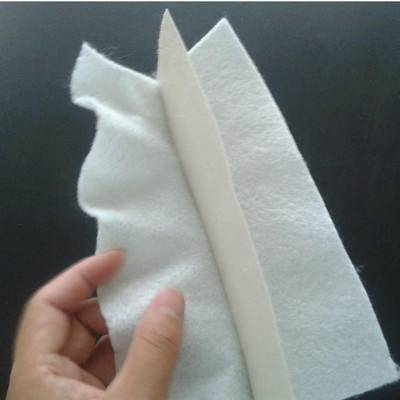



Qingdao Jijing 1700g+impermeable geotextile material is highly favored
Category:
building materials/Geosynthetic materials/Drainage materials
Model:
200-2500g/square meter
Brand:
Kind
Retail Price
Negotiable
重量
kg
- Product Description
-
Description :
Qingdao Jijing News 1700g+Impermeable geotextileThe material is highly favored
Qingdao Jijing News 1700g+impermeable geotextile materials are highly favored
Waterproof board, also known as geomembrane characteristics
Strength - Under the same weight specifications, the tensile strength in all directions is higher than other needle punched non-woven fabrics.
Anti UV light exposure - has extremely high UV resistance.
Extreme high temperature resistance - able to withstand temperatures up to 230 ℃, maintaining structural integrity and original physical properties at high temperatures.
Permeability and plane drainage - The waterproof board is thick and needle punched, with good plane drainage and vertical permeability, and can still maintain this performance after many years.
Creep resistance - Creep resistance is superior to other geotextiles, therefore it has good long-term performance. It can withstand the erosion of common chemical substances in soil and the corrosion of gasoline, diesel, etc.
Ductility - It has a good elongation under certain stress, allowing it to adapt to uneven and irregular surfaces.
Qingdao Jijing News 1700g+impermeable geotextile materials are highly favored
Two; Characteristics of waterproof board, also known as geomembrane;
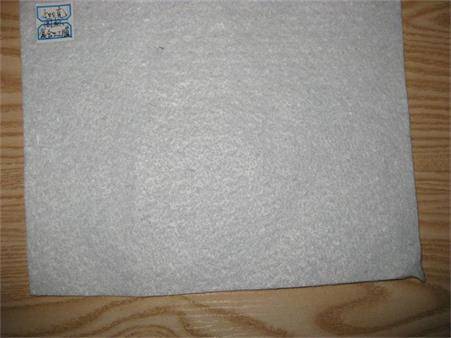
1. Excellent flexibility, impermeability, elongation, and wear resistance; 2. Has good isolation and puncture resistance; 3. No chemical pollution. 4. Resistant to acid, alkali, and various chemical substances, with good dimensional stability, good adhesion, and easy construction.
Shandong Jinde Geotechnical Materials Co., Ltd. is located in the national geotechnical material production base--Laiwu District, Jinan City, is a manufacturer of geosynthetic materials and waterproofing membranes, produced by the company;EVA\ECBTunnel composite waterproof boardglossy/Single hair surface/Double haired surface),LDPE\HDPEGeomembrane (waterproof board),Composite geomembrane, needle punched non-woven geotextile, woven geotextile, bentonite waterproof blanket(GCL)Plastic drainage board (double-sided concave convex type, square type) grass grid, soft permeable pipe (spring blind pipe),PEPipe, plastic blind ditch (board), double (single) arm perforated corrugated pipe, geogrid (fiberglass steel plastic unidirectional and bidirectional), composite drainage network, geogrid room, soundproof felt and other products.

Composite waterproof board; A waterproof material formed by thermal composite of polyester polyester short filament (long filament) geotextile and waterproof board. Width of 1-6 meters, width of waterproof board for tunnels, subways, and culverts; 1-3m, The main specifications are:; 1.0mm/200g,1.2mm/300g,1.5mm/300g,1.5mm/350g,200g/1.0mm/200g,250g/1.5mm/250g。 We can produce according to customer requirements. Composite forms include; Sling style, strip style, fully composite, two fabric composite, one fabric composite. Its main role in engineering; Waterproof and anti-seepage. The product has high physical and mechanical performance indicators such as tensile strength, tear resistance, and burst resistance. It has the characteristics of high strength, good elongation, large deformation modulus, acid and alkali resistance, corrosion resistance, aging resistance, and good anti-seepage performance. It can meet the needs of civil engineering such as anti-seepage, isolation, reinforcement, crack prevention and strengthening in water conservancy, municipal engineering, construction, transportation, subway, tunnel, and engineering construction. Due to the use of polymer materials and the addition of anti-aging agents in the production process, it can be used in unconventional temperature environments
Composite geotextile, also known as impermeable geotextile, anti-seepage geotextile, waterproof geotextile, anti-seepage membrane (composite geotextile has the same function as geomembrane). Composite geomembrane is a type of geotextile applied to one or both sides of a thin film. Specifications include; One cloth and one film, two cloths and one film, two films and one cloth, three cloths and two films (commonly known as one cloth and one film, two cloths and one film) weighing 200-1200 grams, width; 1-6 meters. Composite geomembrane products have high physical and mechanical performance indicators such as tensile strength, tear resistance, and burst resistance. They have high strength, good elongation, large deformation modulus, acid and alkali resistance, corrosion resistance, aging resistance, and good anti-seepage performance. Can meet the needs of water conservancy (artificial lake), municipal, construction, transportation, subway, tunnel, aquaculture (lotus pond), water channel, fish pond aquaculture. Civil engineering needs such as anti-seepage, isolation, reinforcement, and crack prevention reinforcement in engineering construction. Due to the use of polymer materials and the addition of anti-aging agents in the production process, it can be used in unconventional temperature environments. Commonly used for anti-seepage treatment of dams, drainage ditches, and anti pollution treatment of waste sites.
7. After the anti-seepage membrane is laid
One; Characteristics of composite geomembrane;
Width up to 6m, (composite geomembrane weighing over 400g can be welded with edges thrown around)
High puncture resistance and high friction coefficient
Good aging resistance and adaptability to a wide range of environmental temperatures
Excellent anti drainage performance
Suitable for water conservancy, lotus pond, aquaculture, artificial lake, chemical industry, construction, transportation, subway, tunnel, garbage disposal site and other projects
Composite geomembranes are mainly applied in five major fields
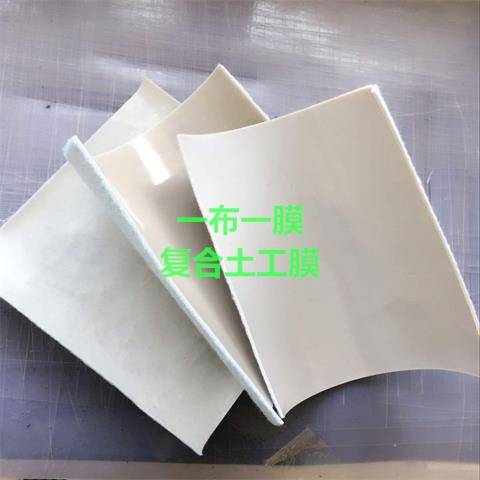
1. Environmental protection and sanitation. It effectively solves the problem of environmental pollution caused by urban solid waste and can avoid continuous pollution to the environment.
2. Water conservancy engineering is used for dam foundation reinforcement, drainage board for underground water drainage, and pressure reduction.
3. Various anti-seepage projects such as soft soil foundation reinforcement and drainage in municipal construction engineering
4. Petrochemical system, chemical wastewater tank anti-seepage, refinery wastewater tank anti-seepage, electroplating acid pickling tank anti-seepage and anti-corrosion, pipeline lining, etc.
5. Road traffic facilities, anti-seepage and diversion reinforcement under ballast, anti-seepage reinforcement of culverts and tunnels, underground water drainage and circuit moisture-proof protection.
Shandong Jinde Geotechnical Materials Co., Ltd. is located in the national geotechnical material production base--Laiwu District, Jinan City, is a manufacturer of geosynthetic materials and waterproofing membranes, produced by the company;EVA\ECBTunnel composite waterproof board(glossy/Single hair surface/Double haired surface),LDPE\HDPEGeomembrane (waterproof board),Composite geomembrane, needle punched non-woven geotextile, woven geotextile, bentonite waterproof blanket(GCL)Plastic drainage board (double-sided concave convex type, square type) grass grid, soft permeable pipe (spring blind pipe),PEPipe, plastic blind ditch (board), double (single) arm perforated corrugated pipe, geogrid (fiberglass steel plastic unidirectional and bidirectional), composite drainage network, geogrid room, soundproof felt and other products.
Two; Construction plan;
Geotextile serves as a protective layer for the film, preventing damage to the anti-seepage layer. In order to reduce the ultraviolet radiation and increase the anti-aging performance, the embedding method is adopted.
During construction, the first step is to use smaller diameter sand or clay to level the base surface, and then lay it. Do not tighten too tightly, the two ends should be buried in the soil in a corrugated shape, and then a layer of about 10cm transition layer should be laid on top with fine sand or clay. Build 20-30cm stone blocks (or precast concrete blocks) as a protective layer against erosion. During construction, efforts should be made to avoid stones directly hitting the composite film, and the construction of the protective layer should be carried out while laying the film. It should be connected to the surrounding structures using expansion bolts and steel plate pressure strips for anchoring, and the connecting parts should be coated with emulsified asphalt (2mm thick) for bonding to prevent leakage at that location.
AfterSalesService :
Key words:- Impermeable geotextile


