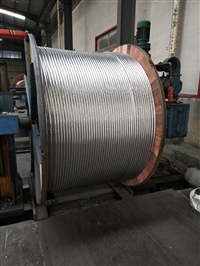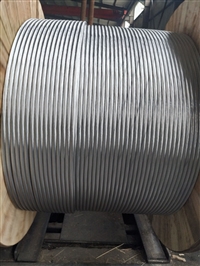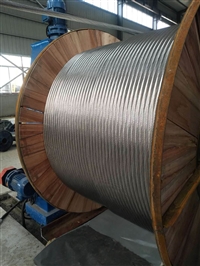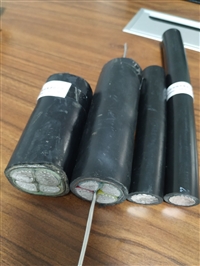
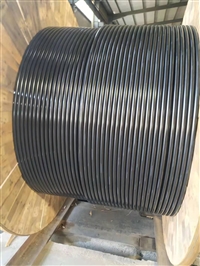


JKLYJ-10kv-35mm2 overhead insulated line factory direct supply
Category:
Electrical Engineering/Wire and cable/Insulated wire
Model:
JKLYJ-10kv-35mm2
Brand:
Zheng Fan
Retail Price
2.16USD
重量
kg
- Product Description
-
Description :


JKLYJ-10KV-35 model overhead insulated wire manufacturer welcomes inquiries
The main characteristics of overhead insulated conductors are:
The insulation performance of overhead insulated wires is good. Due to the addition of an insulation layer, overhead insulated conductors have superior insulation performance compared to bare conductors, which can reduce the distance between lines, lower the insulation requirements for line supports, and increase the number of circuits installed on the same pole.
Good anti-corrosion performance. Due to the insulation layer on the outer layer, overhead insulated wires are less susceptible to oxidation and corrosion than bare wires, and have stronger corrosion resistance, which can extend the service life of the line.
Prevent external damage, reduce the influence of external factors such as trees, flying objects, metal films, and dust, and minimize phase to phase short circuits and grounding accidents.
The strength meets the requirements. Although the insulated wire lacks a steel core, it is tough and makes the mechanical strength of the entire wire meet the requirements of stress design.
Specification of 2 overhead insulated conductors
Line heart. There are two types of overhead insulated conductors: aluminum core and copper core. In the distribution network, aluminum core is widely used, mainly because aluminum is relatively light and cheap, with low requirements for line connectors and supports. In addition, the original distribution lines mainly use steel core aluminum stranded wires, and the use of aluminum core wires is convenient for connecting with the original network. Aluminum core wire is also commonly used in practical applications. Copper core wires are mainly used as down conductors for transformers and switchgear.
Insulation material. There are two types of insulation protection layers for overhead insulated conductors: thick insulation (3.4mm) and thin insulation (2.5mm). Thick insulation allows frequent contact with trees during operation, while thin insulation only allows short-term contact with trees. The insulation protection layer is divided into cross-linked polyethylene and lightweight polyethylene, with cross-linked polyethylene having better insulation performance. The commonly used 10kV overhead insulated conductors are shown in Table 1.
?
3. Installation method of overhead insulated wires
Conventional single laying method. This installation method uses conventional cement poles, iron accessories, and ceramic insulator accessories with bare conductors, and is more suitable for the renovation of old lines and areas with sufficient corridors.
Single laying uses specially designed insulation brackets to suspend wires, which can increase the number of circuits installed, save line corridors, and reduce the unit cost of the line.
4 Application areas of overhead insulated conductors
Suitable for areas with multiple trees. The installation and maintenance of bare wire lines in areas with many trees often have a significant impact on greening and forestry. The use of overhead insulated wires can reduce tree felling (during the initial installation and operation maintenance stages), solve many problems, reduce conflicts with departments such as greening and forestry, protect the ecological environment, beautify the city, and reduce line grounding faults.
Used in areas with frequent flying metal dust and pollution. In the old industrial area, due to inadequate environmental protection standards, metal processing enterprises often have flying metal dust in the wind. Causing short circuits and grounding faults in overhead distribution lines in polluted areas of thermal power plants and chemical plants. The use of overhead insulated conductors is a better way to prevent short-circuit grounding of 10 kV distribution lines.
Suitable for salt spray areas. Salt spray causes severe corrosion to bare wires, greatly reducing their tensile strength. When exposed to wind and rain, it can lead to wire breakage, causing short-circuit grounding accidents and shortening the service life of the line. The use of overhead insulated wires can effectively prevent salt spray corrosion. Because of the insulation layer protection, it can reduce the corrosion of conductors by salt spray, delay the aging of the circuit, and extend the service life of the circuit.
Suitable for areas with frequent lightning strikes. Due to a layer of insulation protection, overhead insulated conductors can reduce lightning strikes on the line, and even if there is lightning, the impact will be much smaller. In the minefield, the insulation of the lines erected with bare wires generally decreases rapidly, and there are often ground burst accidents. After replacing with overhead insulated wires, the power outage time for grounding faults can be reduced.
Suitable for the renovation of old urban areas. Due to the fact that overhead insulated wires can withstand a voltage of 15kV, the small vertical distance between insulated wires and buildings is 1m, and the horizontal distance is 0.75m. Therefore, replacing the low-voltage main line with 10kV overhead insulated wires and directly sending them to the load center to shorten the radius of the low-voltage power grid is an effective distribution method for urban renewal.
Beneficial for preventing typhoons. Due to the poor typhoon resistance of overhead bare wire lines, the line trips one after another when a typhoon arrives. After using overhead insulated wires, the instantaneous collision of wires will not cause short circuits, reducing faults and greatly improving the typhoon resistance of the line.
Model introduction: Taking JKLYJ-10KV-35mm2 as an example:
The letters JKLYJ represent the model number
10KV represents the voltage level
35mm2 represents cross-sectional area
All aluminum 10KV overhead insulated conductor, in accordance with standard GB/T14049/2008
Design and Construction of 5 Overhead Insulated Conductors
Insulated wire. The allowable current carrying capacity of commonly used overhead insulated conductors is shown in Table 2.
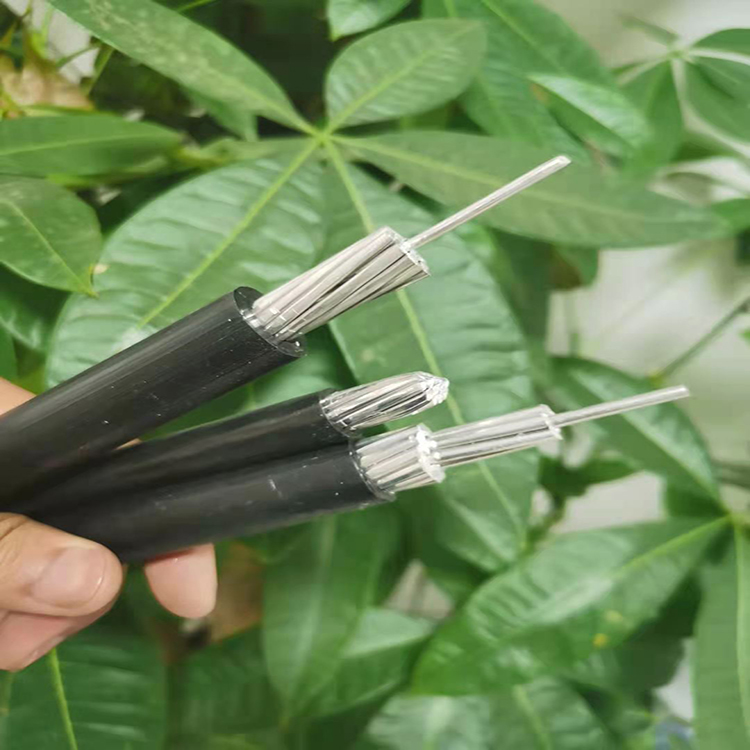
Note: 1 PVC - a weather resistant insulation material based on polyvinyl chloride;
2. PE polyethylene based weather resistant insulation material.
From Table 2, it can be seen that the current carrying capacity of insulated wires and steel cored aluminum stranded wires within the same specification is smaller than that of bare wires. Because after adding insulation layer to insulated wires, the heat dissipation of the wires is poor, and their current carrying capacity is about one level lower than that of bare wires. Therefore, when designing and selecting, insulated wires should be selected in a larger range. At the same time, the tension clamp is directly clamped on the insulator of the wire to prevent excessive tension on the wire, which may cause cracks or peeling in the insulation layer. Generally, the use stress of insulated wires is around 41N/mm2.
Wire arrangement and spacing. The wire arrangement of overhead insulated power lines is basically the same as that of bare wire lines, and can be divided into three types: triangular, vertical, horizontal, and multi circuit installation on the same pole. The span of overhead insulated lines should be controlled at 50m.
The phase to phase distance of insulated wires. Due to the excellent insulation performance of overhead insulated conductors, the phase to phase distance is smaller than that of bare conductor lines, but the phase to phase distance for vertical and triangular arrangements is not less than 0.3m; the phase to phase distance for horizontal arrangements is not less than 0.4m. The vertical and horizontal distances between two circuits of the same pole shall not be less than 0.5m. The clearance distance between jumper joints, down conductors and adjacent phase leads and low-voltage lines, as well as the clearance distance between overhead insulated conductors and pole wires or structures, shall not be less than 0.2m.
Connection of insulated wires. The connection of insulated wires is not allowed to be wrapped, and insulated wires should not be connected within the span as much as possible. They can be connected when using tension pole jumpers. If it is necessary to connect within a span, each wire cannot exceed one connector within a span, and the distance between the connector and the fixed point of the wire should not be less than 0.5m. Insulated wires of different metals, specifications, and twisting directions are strictly prohibited from making load-bearing connections within a span. The connection points of insulated wires should be wrapped with insulation covers or self-adhesive insulation tape.
The sag of insulated wires. After the installation of the wire, considering the influence of plastic elongation on sag, the sag reduction method should be used for compensation. The percentage of sag reduction is 20% for aluminum or aluminum alloy core insulated wire and 7%~8% for copper core insulated wire. When tightening the wire, the insulated wire should not be pulled too much. After the wire is tightened, the looseness of each phase wire in the same gear should strive to be consistent.
Fixing of insulated wires. Insulated wires and insulators are fixed using insulated zip ties. The tying of needle or rod insulators, straight rods are tied using the top groove tying method, and direct angle rods are tied using the edge groove inner tying method, tied to the outer corner side groove of the line. The screw type insulator is tied in the edge groove, and the contact part between the insulated wire and the insulator should be wrapped with insulating self-adhesive tape.
Construction and installation of insulated conductors. The construction and installation of insulated wires is different from overhead bare wires. It does not allow the wires to damage the insulation layer during construction. During construction, attention should be paid to the protection of the insulation layer, and friction between the wire insulation layer and the ground and tower accessories should be avoided as much as possible.
Overlapping of insulated wires and overhead wires. The connection of jumper wires and drop wires for insulated wires is different from that of bare wires, as insulated wires require specialized wire stripping pliers to strip the insulation layer, which is a complex process with strict requirements. The jumper connection can be made using parallel groove clamps or splicing tubes. The lead wire can be connected using parallel groove clamps or T-shaped clamps. At the same time, the interface should be wrapped with an insulating cover or insulating self-adhesive tape.
The combination of ordinary fittings and insulated wires. Overhead insulated conductors have dedicated line fittings that can insulate the entire line. From the perspective of line cost, ordinary accessories can also be combined to reduce the cost of the line. Due to the additional insulation layer on the insulated wire, the wire diameter is larger than that of the bare wire. When using ordinary fittings, the wire fixing fittings and connecting fittings need to be enlarged in size. The tension clamp should be clamped together with the protective layer of the conductor to prevent the stripping of the overhead insulated conductor, which affects its mechanical and insulation properties. JKLYJ-10KV-35mm2 model overhead insulated wire manufacturer welcomes inquiries

AfterSalesService :
Key words:- Direct supply from overhead insulated line factory
More Products