
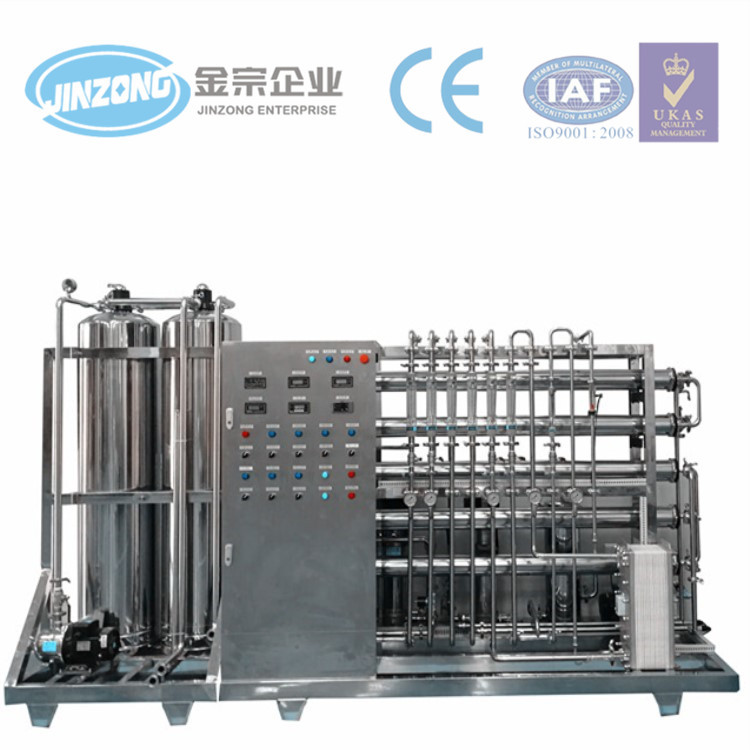
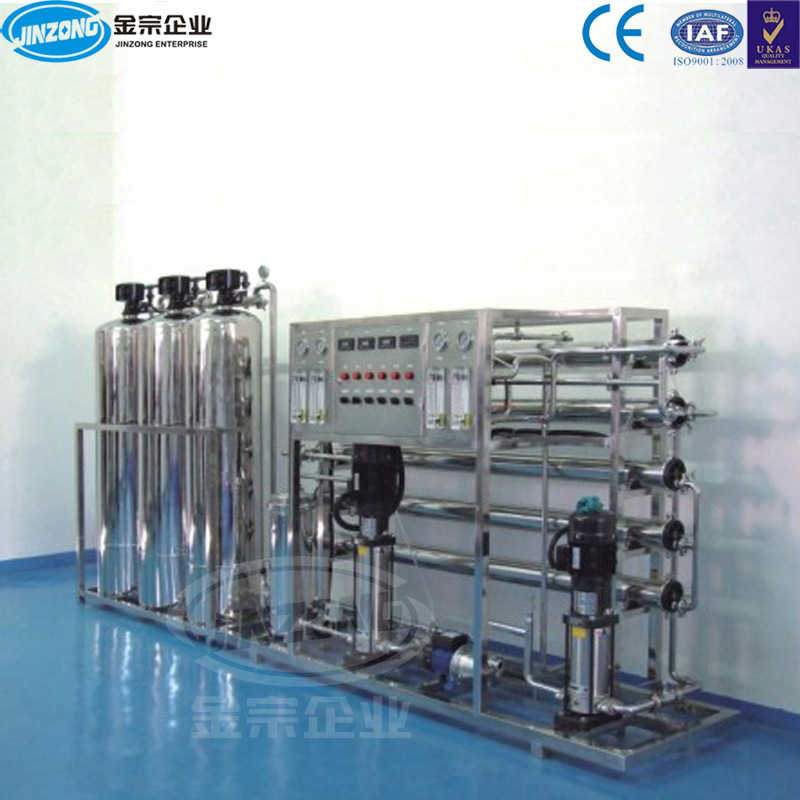
JRO Reverse Osmosis Water Treatment Equipment Manufacturer
Category:
Environmental Protection/Raw water treatment equipment/Reverse osmosis equipment
Model:
Brand:
Jinzong Machinery
Retail Price
Negotiable
重量
kg
- Product Description
-
Description :
The pretreatment system of reverse osmosis water treatment equipment usually consists of polypropylene fiber (PP) filters and activated carbon (AC) filters. For raw water with high hardness, a softening resin filter needs to be installed. PP filter element can efficiently remove mechanical particle impurities, rust, and large gel like substances above 5 μ m in raw water, protecting subsequent filters. Its characteristics are large pollutant capacity and low price. AC activated carbon filter can efficiently adsorb residual chlorine and some organic matter and colloids in raw water, protecting polyamide reverse osmosis composite membranes from residual chlorine oxidation. Softening resin can remove most of the calcium and magnesium ions in raw water, prevent subsequent scaling and blockage of the RO membrane surface, and improve water recovery rate.
The main reason for the performance degradation of reverse osmosis membranes is due to surface contamination, such as surface scaling and membrane blockage; Or it may be caused by physical and chemical changes in the membrane itself. The physical changes are mainly caused by the compaction effect, which leads to a decrease in the permeability of the membrane; Chemical changes are mainly caused by fluctuations in pH value, such as hydrolysis of cellulose acetate membrane; Free chlorine can also deteriorate the performance of aromatic polyamide membranes. The main reason for fouling and blockage of reverse osmosis membranes is due to membrane surface deposition and microbial growth. Microorganisms not only block the membrane, but also have an erosive and damaging effect on cellulose acetate. Therefore, a certain amount of residual chlorine must be maintained inside the membrane, but if the residual chlorine is too high, it can cause a decrease in membrane performance. Therefore, residual chlorine should be maintained at 0.1-0.5mg/L before the cellulose acetate membrane, and less than 0.1mg/L before the aromatic polyamide membrane.
The working principle of a reverse osmosis membrane is to separate pure water from a solution containing solutes using a semi permeable membrane that can only pass through water. At this point, the water on the pure water side spontaneously passes through the semi permeable membrane and enters the solution side, causing the water level on the solution side to rise. This phenomenon is called permeation. When the liquid level rises to a certain height, the pressure on both sides of the membrane reaches equilibrium, and the liquid level on the solution side no longer rises. At this point, there is a pressure difference on both sides of the membrane, called osmotic pressure. If a pressure greater than the osmotic pressure is applied to the solution side, the water molecules in the solution will be squeezed to the pure water side, which is exactly the opposite of osmosis. We call this reverse osmosis. We can see from the process of reverse osmosis that due to pressure, water molecules in the solution enter pure water, increasing the amount of pure water while the solution itself is concentrated. The principle of reverse osmosis desalination is to apply a pressure greater than natural osmotic pressure, causing the permeation to proceed in the opposite direction, pressing the water molecules in the raw water to the other side of the membrane, thereby achieving the goal of removing salt from water. This is the principle of reverse osmosis membrane desalination.
AfterSalesService :
Key words:- JRO reverse osmosis water treatment equipment