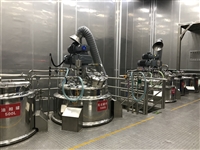
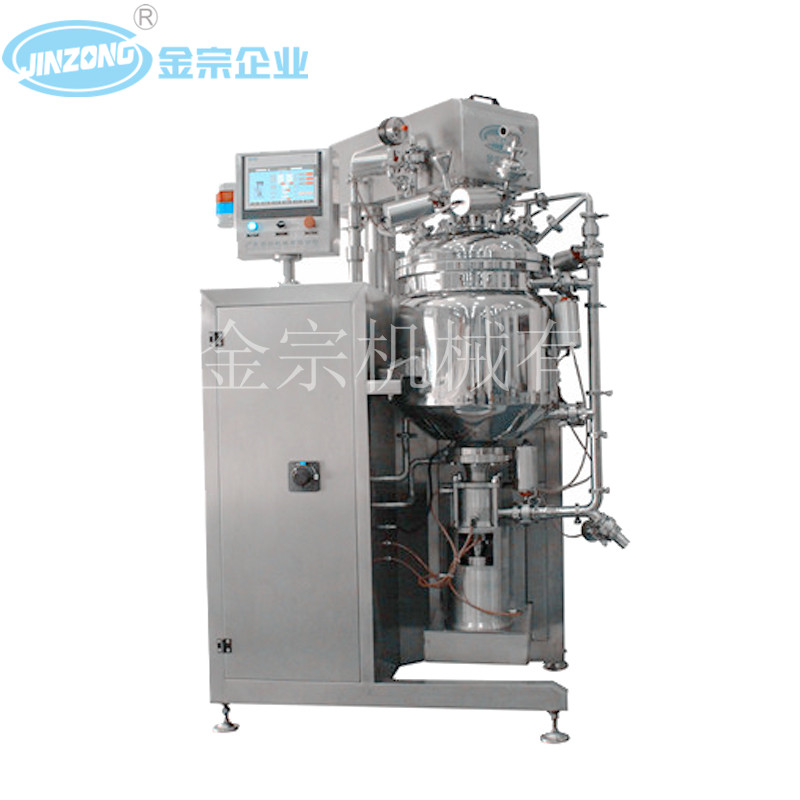

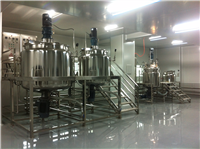
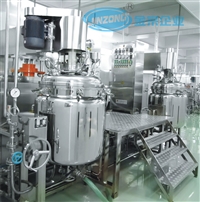
JRK Homogenizer Emulsifier Toothpaste Production Line
Category:
chemical industry/Mixing equipment/Emulsifying machine
Model:
JR
Brand:
Jinzong Machinery
Retail Price
50,000.00USD
重量
kg
- Product Description
-
Description :
The ultra-high speed high shear homogenizer emulsifier is a device that efficiently, quickly, and uniformly transfers one or more phases (liquid, solid) into another immiscible continuous phase (usually liquid). When the fineness of one or more materials reaches the micrometer or even nanometer level, the system can be considered homogeneous. When external energy is input, the two materials recombine into a homogeneous phase. The high shear homogenizer, due to the strong kinetic energy brought by the high tangent speed and high-frequency mechanical effect generated by the high-speed rotation of the rotor, makes the materials subject to intense mechanical and hydraulic shearing, centrifugal extrusion, liquid layer friction, impact tear and turbulence in the narrow gap between the stator and rotor, forming suspension (solid/liquid), lotion (liquid/liquid) and foam (gas/liquid). The high shear homogenizer instantly disperses and emulsifies immiscible solid, liquid, and gas phases uniformly and finely under the combined action of corresponding processes and appropriate additives. Through the cyclic operation of the high-frequency pipeline high shear dispersion homogenizer, stable high-quality products are finally obtained.

The properties of emulsification: Emulsification is the process of dispersing a liquid in extremely small droplets uniformly in another immiscible liquid. Emulsification is a liquid-liquid interface phenomenon in which two immiscible liquids, such as oil and water, are separated into two layers in a container, with the lower density oil in the upper layer and the higher density water in the lower layer. If appropriate surfactants are added and stirred vigorously, the oil is dispersed in water to form an emulsion, which is called emulsification.
A system formed by dispersing particles (droplets or liquid crystals) in another immiscible liquid is called an emulsion. When forming an emulsion, the interfacial area between the two liquids increases, making the system thermodynamically unstable. In order to stabilize the emulsion, another component, an emulsifier, needs to be added to reduce the interfacial energy of the system. Emulsifier belongs to a type of surfactant, and its typical function is to emulsify. The phase that exists in the form of droplets in an emulsion is called the dispersed phase, also known as the internal phase or discontinuous phase; And the other connected entity is called a dispersed medium, also known as an external phase or continuous phase. Emulsion vacuum emulsifier
Emulsifier mainly refers to the use of high shear emulsifiers to quickly and uniformly distribute one or more phases into another continuous phase in a vacuum state. It utilizes the strong kinetic energy brought by machinery to enable the material to withstand hundreds of thousands of hydraulic shear cycles per minute in the narrow gap between the stator and rotor. Centrifugal extrusion, impact tearing, and other comprehensive methods are used to instantly and uniformly disperse and emulsify the product. After high-frequency cycles, high-quality products with no bubbles, delicate texture, and stability are finally obtained.
The homogenizer emulsifier has the following main characteristics:
1. The pressure control of the homogenizer emulsifier mainly relies on the use of two pole mechanical pressure regulation, which is very convenient to adjust and also very safe and reliable;
2. The plunger of the homogenizer emulsifier is mainly made of highly wear-resistant alloys, as well as new processes such as sprayed alloys and ceramics, which have strong corrosion resistance and wear resistance;
3. The high-pressure sealing of the plunger of the homogenizer emulsifier mainly uses various forms such as self expanding rings and V-shaped seals, which have a very long service life;
4. The transmission of the crankshaft of the homogenizer emulsifier mainly uses a first-order transmission method, which runs very smoothly, with very little power loss and very low noise;
5. The main components of the homogenizer emulsifier are made of stainless steel and highly corrosion-resistant alloys, which meet the hygiene requirements of food very well.




AfterSalesService :
Key words:- JRK homogenizer emulsifier