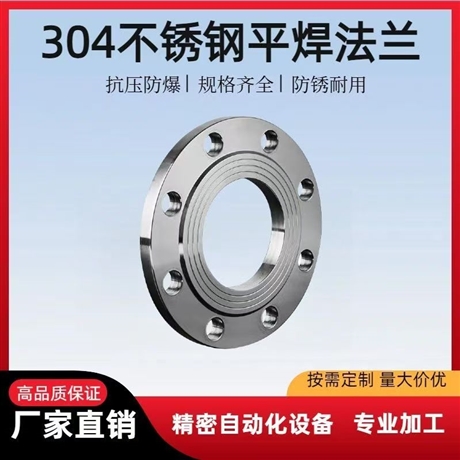

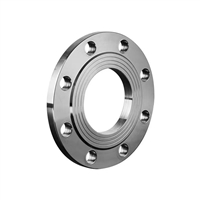
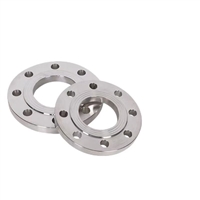
New national standard 304 stainless steel flange welding flange for chemical shipyard support customization
Category:
building materials/Pipe fittings/Flange plate
Model:
DN100
Brand:
Cangzhou pipeline fittings
Material:
304 stainless steel
Execution Standard:
New National Standard
connection method:
welding
Applicable Industries:
Chemical industry, shipyard, oil and natural gas
Surface Treatment:
Acid washing/sandblasting
Product Type:
Flanges/Flanges
customized service:
Customization Supported
Place of Origin:
Cangzhou
Retail Price
10,000,000.00USD
重量
kg
- Product Description
-
Material 304 stainless steel
Execution Standard New National Standard
connection method welding
Applicable Industries Chemical industry, shipyard, oil and natural gas
Surface Treatment Acid washing/sandblasting
Product Type Flanges/Flanges
customized service Customization Supported
Place of Origin Cangzhou
Description :
Stainless steel flange is the core connecting component used in pipeline systems to connect pipes, valves, or equipment, mainly solving the problems of pipeline sealing and fixation. This product is produced in strict accordance with the new national standard. It is made of 304 stainless steel, and has excellent corrosion resistance and mechanical strength. It is especially suitable for working conditions with high requirements for material weather resistance such as chemical industry and shipyards. As a type of welded flange, it is connected to the pipeline through butt welding to ensure stability and safety during fluid transmission, and is an indispensable basic component in industrial pipeline installation.
The stainless steel flange plate complies with the latest national standards and is made of authentic 304 stainless steel. Its chemical composition meets the GB/T 20878 standard and its nickel chromium content meets the standard, ensuring that it is not easily rusted in humid, acidic or alkaline environments. The flatness of the disc surface is high, the distribution of bolt holes is uniform, and the dimensional tolerance is controlled within millimeters, meeting the requirements of series standards such as HG/T 20592 or GB/T 9119. The surface is treated with acid pickling or sandblasting to remove oxide scale, presenting a metallic color without cracks or sand holes. The standard welding groove angle facilitates on-site welding, ensures the quality of the weld seam, and meets the testing requirements of various physical environments such as high pressure, high temperature, and low temperature.
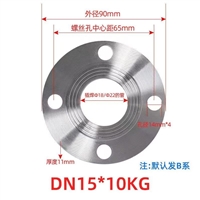
When selecting, it is necessary to specify the pipeline pressure rating (such as PN10/PN16/PN25), nominal diameter (DN15-DN2000, etc.), and connection form. This product is a welded flange, suitable for situations that require high-strength connections. Unlike flat or butt welded flanges, its structure is more compact. If the working conditions involve highly corrosive media, it is necessary to confirm whether the 304 material meets the requirements, and if necessary, upgrade to 316L material. Not suitable for special working conditions with ultra-high pressure or extreme temperature differences, such scenarios require the use of forged flanges or special alloy materials. When purchasing, it is necessary to verify the dimensions on the drawing to ensure that the center distance of the bolt holes is consistent with the matching flange, in order to avoid installation errors.
Before installing stainless steel flanges, it is necessary to clean the pipeline ports and flange sealing surfaces to ensure that there are no impurities such as oil stains or rust. During welding, argon arc welding or manual arc welding should be used, and attention should be paid to controlling the interlayer temperature to prevent intergranular corrosion from causing a decrease in material properties. The typical service life can reach more than 10 years, depending on the corrosiveness of the medium. Regular inspection of bolt tightening is required for daily maintenance to prevent loosening and leakage; Observe whether there are any erosion marks or corrosion points on the sealing surface. Common faults include weld cracking or sealing surface leakage, which are often caused by poor installation alignment or improper welding processes. If abnormalities are found, they should be promptly shut down for maintenance, replaced with gaskets or re welded to ensure the long-term stable operation of the pipeline system.
AfterSalesService :
Key words:
More Products