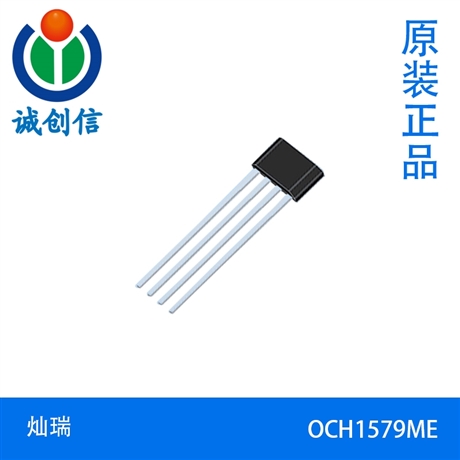

Canrui OCH1579ME DC brushless motor driven fan driver
Category:
electron/Integrated Circuit/IC/Drive IC
Model:
OCH1579ME
Brand:
Canrui
Working voltage:
2.5V-5.5V
Operating temperature:
-40℃~+85℃
package form:
SOT-23-3/TO-92S
output type:
Digital switch quantity
quiescent current:
Typical value 3.5mA
Response frequency:
Up to 100kHz
ESD protection:
HBM±4kV
sensitivity:
high sensitivity
Retail Price
10,000,000.00USD
重量
kg
- Product Description
-
Working voltage 2.5V-5.5V
Operating temperature -40℃~+85℃
package form SOT-23-3/TO-92S
output type Digital switch quantity
quiescent current Typical value 3.5mA
Response frequency Up to 100kHz
ESD protection HBM±4kV
sensitivity high sensitivity
Description :
OCH1579ME is a high-performance Hall effect sensor integrated circuit designed by Canrui Technology, mainly used to detect magnetic field changes and convert them into electrical signals for output. This device solves the problem of traditional mechanical switches being prone to wear and short lifespan in harsh environments, and is particularly suitable for typical working conditions that require non-contact position detection, speed measurement, and current sensing. As a unipolar Hall switch, it outputs a high level when there is no magnetic field or the magnetic field strength is below the release point, and outputs a low level when the magnetic field strength exceeds the operating point. It has extremely high stability and reliability and is widely used in consumer electronics, industrial control, and automotive electronics fields.
OCH1579ME adopts the standard SOT-23-3 or TO-92S packaging form, with a compact size that is easy to surface mount or plug-in install, in line with the design trend of modern electronic device miniaturization. It integrates high-sensitivity Hall elements, signal amplifiers, Schmitt triggers, and output driver stages internally, ensuring pure signal purity and stable output. The working voltage range usually covers 2.5V to 5.5V and is compatible with most low-voltage logic circuit systems. This chip follows strict semiconductor manufacturing standards, undergoes high-temperature aging testing and electrostatic protection treatment, and has excellent anti-interference ability and temperature stability. The operating temperature range is usually between -40 ℃ and+85 ℃, meeting the requirements of industrial applications.
During the selection process, the purchaser needs to pay close attention to the magnetic characteristic parameters of OCH1579ME, such as the threshold values of the operating point (Bop) and release point (Brp), to ensure compatibility with the backend magnet or magnetic circuit. Compared to linear Hall sensors, OCH1579ME, as a switch type device, outputs digital signals and is more suitable for scenarios such as limit switches and speed counting. If the application scenario requires analog output or higher precision magnetic field measurement, linear Hall or angle sensor series should be considered. In addition, attention should be paid to its static current consumption. For battery powered handheld devices, low power consumption is a key indicator for selection, and OCH1579ME performs well in this regard, which helps to extend the battery life of terminal products.
When installing OCH1579ME, attention should be paid to the pin definition to avoid device damage caused by reverse grounding of the power supply and ground. It is recommended to parallel decoupling capacitors near the power supply pins to filter out high-frequency noise. In a typical usage cycle, the device requires almost no maintenance, but it is necessary to ensure the stability of the magnetic field source in the working environment and avoid strong electromagnetic interference affecting the judgment logic. Common faults are mostly caused by poor welding or external overvoltage impact, so strict temperature control is required during the surface mount reflow soldering process. In daily maintenance, if detection failure is found, priority should be given to checking whether the magnet position is offset or whether the magnetism is weakened, rather than directly determining sensor failure, in order to reduce misjudgment rate and maintenance costs.
AfterSalesService :
Key words:
More Products