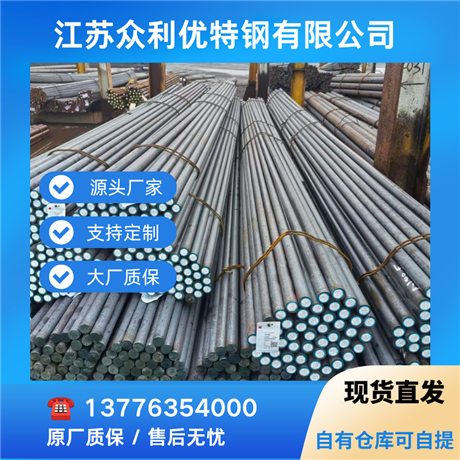

45 High quality carbon structural steel round steel hot-rolled medium carbon steel mechanical parts processing raw materials
Category:
metallurgy/Youte Steel/Carbon bonded steel
Model:
16-500
Brand:
Baowu Special Steel
Execution Standard:
GB/T 699-2015
carbon content:
0.42%-0.50%
tensile strength:
≥600MPa
yield strength:
≥355MPa
elongation:
≥16%
Hardness (hot-rolled):
≤HB229
density:
7.85g/cm³
Delivery status:
Hot rolling/normalizing/annealing
Retail Price
10,000,000.00USD
重量
kg
- Product Description
-
Execution Standard GB/T 699-2015
carbon content 0.42%-0.50%
tensile strength ≥600MPa
yield strength ≥355MPa
elongation ≥16%
Hardness (hot-rolled) ≤HB229
density 7.85g/cm³
Delivery status Hot rolling/normalizing/annealing
Description :
45 # steel is a widely used medium carbon quenched and tempered steel, belonging to the high-quality carbon structural steel series. It mainly solves the material selection problem of mechanical components when subjected to moderate loads and requiring good comprehensive mechanical properties. Typical working conditions include manufacturing structural components with high stress such as shafts, gears, connecting rods, bolts, etc. 45 # steel has a moderate carbon content, and after appropriate heat treatment, it can achieve high strength and a certain degree of plasticity and toughness. It is one of the basic and important raw materials in the mechanical manufacturing industry, suitable for the manufacturing of core components of various general machinery and heavy equipment.
The standard for 45 # steel is usually GB/T 699-2015 "High Quality Carbon Structural Steel". In its chemical composition, the carbon (C) content is generally between 0.42% and 0.50%, the silicon (Si) content is 0.17% -0.37%, and the manganese (Mn) content is 0.50% -0.80%. In the hot-rolled state, the hardness of 45 steel usually does not exceed HB229, and in the annealed state it does not exceed HB197. Tensile strength ≥ 600MPa, yield strength ≥ 355MPa, elongation ≥ 16%, and cross-sectional shrinkage ≥ 40%. These specific physical and chemical indicators ensure the performance stability of 45 steel in subsequent processing and use, meeting the requirements of most industrial standards for medium strength structural steel.
When selecting, 45 steel is suitable for scenarios that require high strength and wear resistance, while not having extreme toughness requirements. If the working conditions require extremely high toughness or low-temperature impact performance, low-carbon alloy steel may need to be considered; If higher strength and larger cross-section are required, alloy quenched and tempered steels such as 40Cr may need to be considered. Compared with ordinary carbon structural steels such as Q235, 45 steel has higher strength and can be strengthened by heat treatment; Compared with 40Cr, the cost is lower, but the hardenability is slightly inferior. The purchaser should clarify the working stress state, size, and whether surface hardening treatment is required for the parts when selecting, in order to determine whether 45 steel is the best cost-effective choice.
Before installation and use, 45 steel usually needs to undergo heat treatment processes such as normalizing, quenching and tempering (quenching+high-temperature tempering), or surface quenching to achieve the required hardness and strength in the design. The typical service life depends on the specific application environment and maintenance conditions, and is generally longer as a structural component. In daily maintenance, attention should be paid to preventing rust, especially in humid environments where oil or paint treatment is required. Common faults such as breakage or excessive wear are often related to improper heat treatment, overload use, or poor lubrication. Attention should be paid to cutting performance during processing. Hot rolled cutting has better machinability, but hard alloy cutting tools are required for high hardness states.
AfterSalesService :
Key words:
More Products