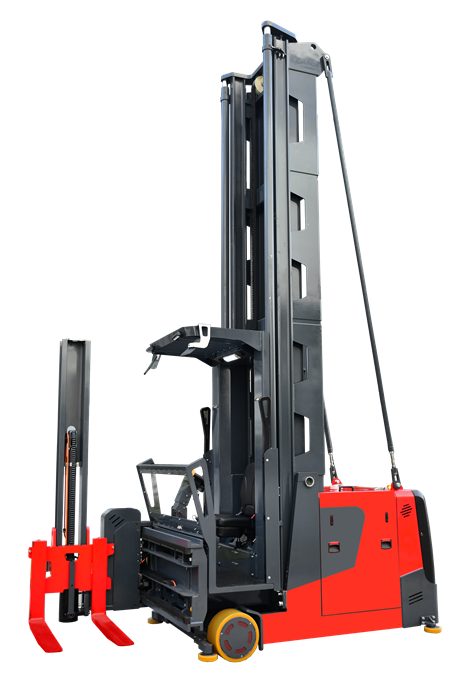

Electric three-way narrow aisle storage forklift for ultra narrow aisle operation to increase storage capacity
Category:
mechanical equipment/construction machinery/forklift
Model:
MCC16
Brand:
thankyou
rated load capacity:
1000-1600kg
Maximum lifting height:
3000-18000mm
Minimum channel width:
1600-1800mm
Drive Type:
AC motor drive
Battery Type:
Lithium battery/lead-acid battery
Fork rotation angle:
90 degrees on both sides
driving speed:
8-10km/h
steering mode:
Electronic steering/wire guided navigation
Retail Price
10,000,000.00USD
重量
kg
- Product Description
-
rated load capacity 1000-1600kg
Maximum lifting height 3000-18000mm
Minimum channel width 1600-1800mm
Drive Type AC motor drive
Battery Type Lithium battery/lead-acid battery
Fork rotation angle 90 degrees on both sides
driving speed 8-10km/h
steering mode Electronic steering/wire guided navigation
Description :
Electric three-way forklift is a material handling equipment designed specifically for high-density storage environments, which solves the pain points of wide aisles and low storage capacity utilization of traditional forklifts. This model can complete the storage and retrieval of goods in extremely narrow alleys without the need for right angle stacking space. Through the three-way rotation function of the fork, it can directly access the shelves on both sides. Typical operating conditions include large logistics centers, cold chain warehouses, and high-level three-dimensional warehouses, which are suitable for scenarios that require high ground flatness and pursue ultimate space utilization, and can significantly increase the storage capacity per unit area.
In terms of specifications, electric three-way forklifts usually use AC drive motors, which have high efficiency and energy-saving characteristics. The width of the vehicle is generally controlled between 1.6 meters and 1.8 meters, suitable for ultra narrow passages ranging from 2 meters to 2.5 meters. The common range of lifting height is 6 meters to 12 meters, and some customized models can reach more than 14 meters, meeting the needs of high-level shelves. The load capacity is mostly in the range of 1 ton to 1.6 tons, which complies with CE or ISO safety certification standards. The battery system is often equipped with lithium batteries or high-performance lead-acid batteries, supporting fast charging and opportunistic charging to ensure the continuity of multi shift manufacturing. The electrical system has overload protection and emergency power-off functions.
When selecting, it is important to consider the actual aisle width and shelf height of the warehouse. If the channel width is less than 2.5 meters and the shelf height exceeds 6 meters, an electric three-way forklift is an ideal choice; If the channel is wider or the height is lower, a forward moving forklift may be more cost-effective. Compared with ordinary forward moving forklifts, three-way forklifts can access goods without turning and have higher efficiency, but they have specific requirements for ground flatness and navigation assistance systems (such as wire or magnetic guidance). Not suitable for outdoor work or environments with poor ground conditions. When purchasing, it is necessary to confirm whether a cab or wireless data transmission module needs to be configured.
In terms of installation and maintenance, electric three-way forklifts need to be used in conjunction with a dedicated guidance system. During installation, the ground guide rails or magnetic strips need to be accurately calibrated to ensure precise driving paths. Daily maintenance should focus on the wear and tear of the driving wheel and load-bearing wheel, and regularly check the sealing of the hydraulic pipeline and the tension of the chain. It is recommended to check the battery level and brake performance before daily homework, and regularly clean the motor dust to maintain good heat dissipation. Common faults such as steering deviation are often caused by dirty guidance sensors, which can be restored by cleaning; Slow hydraulic lifting requires checking the oil level and filter element, and maintaining standardized operation can extend the service life of the entire vehicle.
AfterSalesService :
Key words:
More Products