
National standard hot-dip galvanized anchor bolts, high-strength embedded parts, steel structure, factory equipment fixing special
Category:
hardware/Fasteners, connectors/Anchor bolt
Model:
.
Brand:
Jinning
Material:
Q235B/Q345B/45 # steel
Surface Treatment:
Hot dip galvanized/Dacromet/black parts
thread specification:
M12-M120 can be customized
Execution Standard:
GB/T 799-1988
tensile strength:
≥400MPa
Operating temperature:
-40 ℃ to+80 ℃
Packaging method:
Woven bag/wooden box packing
delivery cycle:
In stock/3-7 day customization
Retail Price
10,000,000.00USD
重量
kg
- Product Description
-
Material Q235B/Q345B/45 # steel
Surface Treatment Hot dip galvanized/Dacromet/black parts
thread specification M12-M120 can be customized
Execution Standard GB/T 799-1988
tensile strength ≥400MPa
Operating temperature -40 ℃ to+80 ℃
Packaging method Woven bag/wooden box packing
delivery cycle In stock/3-7 day customization
Description :
Anchor bolts are key fasteners that connect mechanical equipment or steel structure columns to concrete foundations, mainly addressing safety hazards such as displacement and overturning of heavy equipment during operation and vibration. Its core function is to effectively transfer the load of the upper structure to the foundation, ensuring overall stability. Typical working conditions include installation of large machine tools, fixing of wind turbine towers, connection of bridge supports, and anchoring of steel columns in industrial plants. This category usually consists of screws, base plates, and nut washers, which require extremely high tensile strength and shear resistance to cope with long-term dynamic loads. When selecting, it is necessary to clarify the stress level and environmental corrosiveness, ensure that the anchor bolts match the grade of the foundation concrete, avoid foundation cracking or bolt fracture caused by stress concentration, and ensure the structural safety of the entire life cycle of the project.
In terms of specifications, the common diameter range of anchor bolts is from M12 to M120, and the length is customized according to the burial depth requirements, usually between 300mm and 3000mm. Q235B, Q345B or 45 # steel are commonly used as materials, and surface processes include hot-dip galvanizing, Dacromet treatment or epoxy coating to adapt to outdoor humid or chemical corrosive environments. Refer to industry standards such as GB/T 799-1988 "Anchor Bolts" and JB/ZQ 4763-2006 for implementation standards. The manufacturing process involves cold heading forming, thread rolling, and heat treatment quenching to ensure thread accuracy reaches 6g level and hardness is controlled within the HRC 28-35 range. Each batch of products needs to undergo tensile testing, impact toughness testing, and salt spray corrosion testing to ensure that the yield strength is not less than 235 MPa, the tensile strength meets the design requirements, and the dimensional tolerance is strictly controlled within the allowable range of the national standard to ensure interchangeability and fitting accuracy during on-site installation.
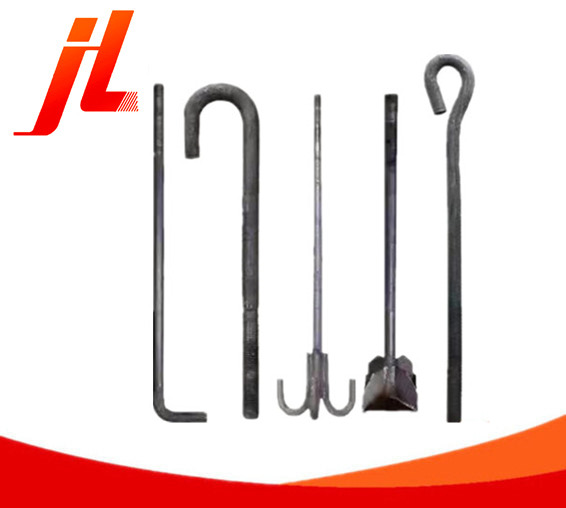
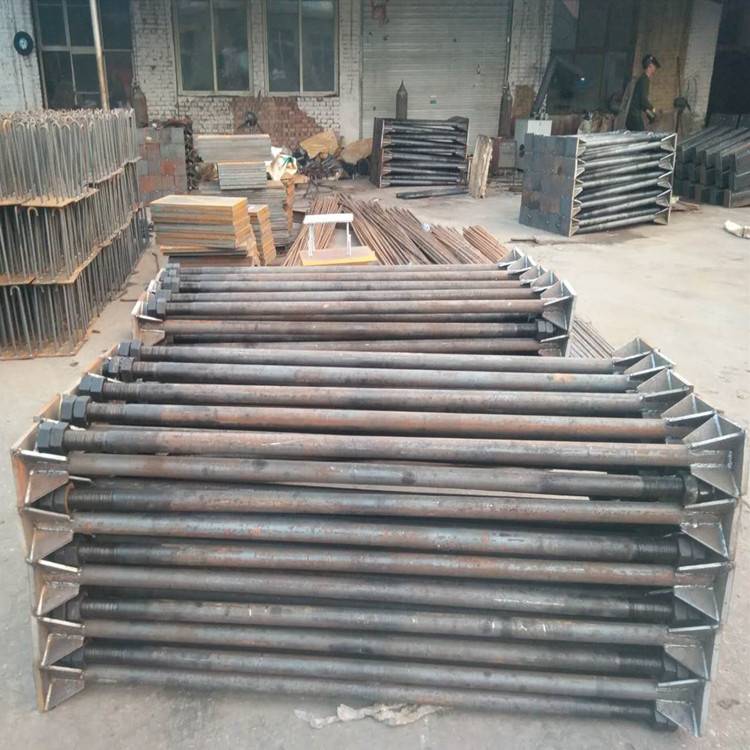
When selecting, it is necessary to distinguish different structural forms such as L-shaped, J-shaped, U-shaped, and welded with bottom plate. L-type and J-type are suitable for light and medium-sized equipment, relying on hooks to provide pull-out resistance; U-shaped is commonly used for pipeline supports; The welded type with bottom plate is used for heavy-duty steel columns to distribute pressure through the bottom plate. If there is strong vibration in the working condition, anchor bolts with shock-absorbing washers or double nut anti loosening design should be selected. For coastal or chemical plant environments with strong corrosiveness, it is necessary to choose 304/316 stainless steel materials or reinforced anti-corrosion coating versions. It should be noted that anchor bolts are different from ordinary expansion bolts. The former is an embedded part that needs to be positioned and fixed before pouring concrete, while the latter is a rear part. Incorrect selection can lead to installation failure or insufficient bearing capacity. It is necessary to determine the specifications based on the load calculation sheet in the design drawings, and it is strictly prohibited to replace large with small.
During the installation and maintenance phase, the positioning accuracy of the anchor bolts directly determines the quality of equipment installation. During construction, it is necessary to use standardized templates or steel reinforcement skeleton to fix bolt groups, with a center deviation controlled within ± 2mm and a verticality deviation not exceeding L/100. During the concrete pouring process, direct contact between the vibrating rod and the bolt should be avoided to prevent displacement or damage to the threads. The exposed threaded part needs to be coated with butter and wrapped with plastic film during maintenance to prevent cement slurry contamination or rust. After the equipment is in place, a torque wrench should be used to tighten the nuts in diagonal order to ensure even force distribution. In daily maintenance, regularly check whether the nuts are loose and whether the anti-corrosion layer is peeling off, especially after experiencing earthquakes, strong winds, or equipment major repairs. If rust is found, it should be promptly removed and repainted. If the threads are damaged, they should be replaced in a timely manner to avoid affecting the overall structural stability.
AfterSalesService :
Key words:
More Products