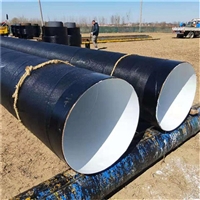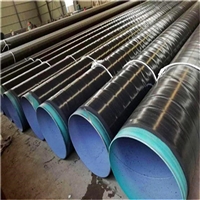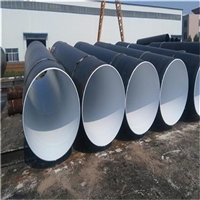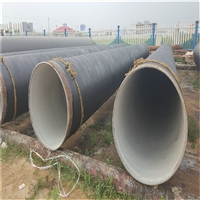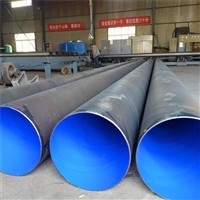
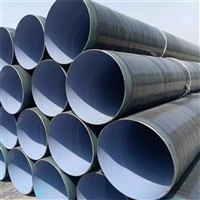


TPEP anti-corrosion steel pipe for water conservancy engineering, drinking water anti-corrosion steel pipe, TPEP anti-corrosion steel pipe manufacturer
Category:
metallurgy/tubing/Spiral tube
Model:
Brand:
Guanghui
Retail Price
412.00USD
重量
kg
- Product Description
-
Description :
External 3PE internal fusion bonded epoxy anti-corrosion steel pipe is made of spiral steel pipe as the substrate, with a three-layer structure of polyethylene anti-corrosion on the outer wall and hot-melt epoxy resin powder anti-corrosion on the inner wall. Under high temperature conditions of 2200C, a steel plastic table gold layer is formed. TPEP (external 3pe internal epoxy powder) anti-corrosion steel pipe. (T, the first letter of Three in English, PE refers to polyethylene, EP refers to epoxy resin). TPEP (external 3pe internal epoxy powder) anti-corrosion is an advanced anti-corrosion technology both domestically and internationally, with a service life of over 50 years.
The use of TPEP anti-corrosion steel pipes is a major breakthrough. If anti-corrosion treatment is not carried out immediately after production, rusting will gradually occur. For water supply steel pipes, even if the corrosiveness of domestic water is small, over time, it will still cause damage to the polyurethane insulation layer and high-density polyethylene protective layer. The inner wall of the protective steel pipe corrodes, causing rust, peeling, and detachment, thereby affecting the service life of the pipeline and the quality of the water supply. Especially for TPEP anti-corrosion steel pipes used for large-diameter long-distance water transportation, their service life is long, corrosion is not easy to detect, and the amount of maintenance and renovation work is large and costly. Therefore, TPEP anti-corrosion steel pipes must be well treated for corrosion prevention. The epoxy resin curing system contains highly active polar groups such as epoxy groups, hydroxyl groups, ether bonds, amine bonds, ester bonds, etc., which endow the epoxy cured material with excellent adhesion to polar substrates such as metals, ceramics, glass, concrete, wood, etc., and have a low curing shrinkage rate. Generally, it is 1% to 2%. It is one of the varieties with low curing shrinkage rate in thermosetting resins. The coefficient of linear expansion is also very small, usually 6 × ℃. So the volume change after curing is not significant, and the processability is good. Therefore, as an external protective layer for buried pipelines, it is very superior. According to relevant information, three-layer PE can extend the service life of buried pipelines to 50 years, and is currently considered as an external anti-corrosion technology for pipelines internationally.


The TPEP anti-corrosion steel pipe industry has entered a new era, and competitive enterprises and practitioners who rely mainly on low prices and disorderly competition will inevitably lose their market. ”Green, environmentally friendly, and energy-saving are the inevitable directions for the development of TPEP anti-corrosion steel pipe manufacturers. Only by accelerating research and development innovation, improving product quality, and enhancing production processes can anti-corrosion steel pipe manufacturers steadily develop in the market. TPEP pipes use hot-melt epoxy technology. What is the difference between hot-melt epoxy and liquid epoxy? Hot melt bonded epoxy on raw materials is solvent-free and uses food grade powder, which is environmentally friendly. However, liquid epoxy has a peculiar odor and is composed of diluents, curing agents, etc. The hot melt bonded epoxy anti-corrosion process for TPEP anti-corrosion steel pipes is hot melt spraying, which reacts with the 250 ℃ steel pipe substrate to form a steel plastic alloy layer. And liquid epoxy is sprayed onto steel pipes by cold spraying, with a longer curing time. Hot melt bonded epoxy has mechanical adhesion, chemical bonding, diffusion, and electrostatic bonding in terms of adhesion, while liquid epoxy only has mechanical interlocking force. The coating thickness of hot-melt epoxy is between 300 and 500um, which has strong resistance to bumps, corrosion, wear, and impact. Liquid epoxy, on the other hand, has a coating thickness of 30-80um, which is rust proof but not corrosion-resistant or water-resistant, and has a drag reducing effect.
AfterSalesService :
Key words:- TPEP anti-corrosion steel pipe


More Products