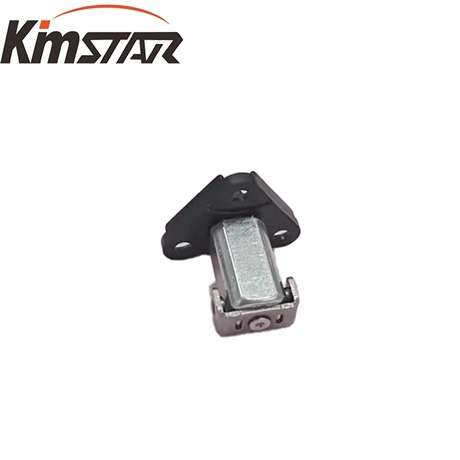

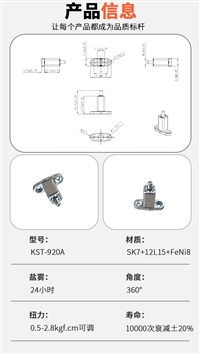
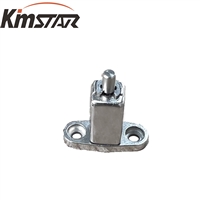
Drone wing folding pivot manufacturer
Category:
hardware/Electronic hardware materials/hinge
Model:
KST-920
Brand:
ginster
Retail Price
9,000,000.00USD
重量
kg
- Product Description
-
Description :
Technical solution for damping core component damping shaft during drone flight
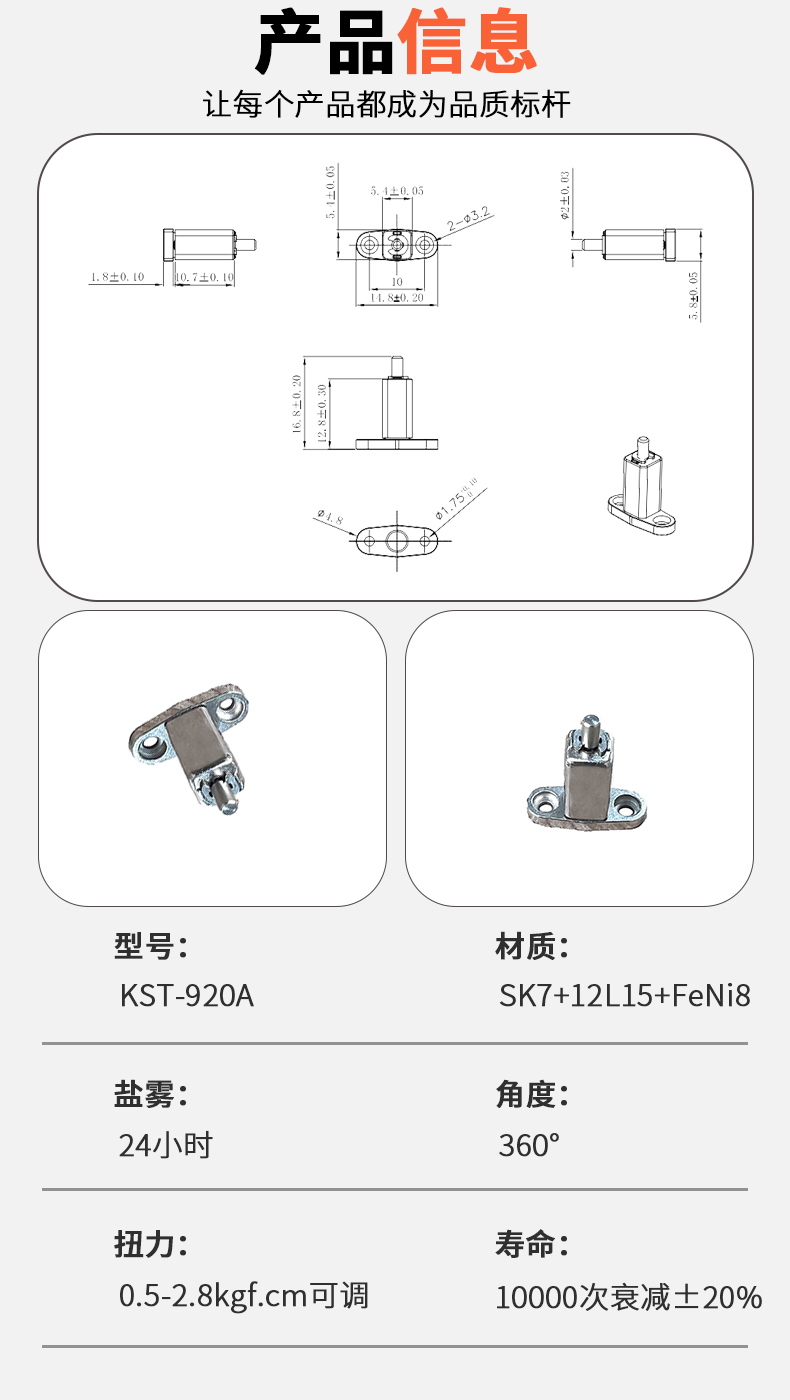
During the flight of unmanned aerial vehicles, the body is affected by multiple factors such as airflow disturbance, motor vibration, and terrain feedback, which can easily generate high-frequency vibrations, directly affecting the stability of pan tilt photography, the accuracy of flight control systems, and the overall flight safety of the aircraft. As the core component of the unmanned aerial vehicle (UAV) shock absorption system, the damping shaft is mainly used in key parts such as the gimbal, boom, and landing gear. Through precise damping control and structural design, it absorbs and attenuates vibration energy, suppresses body resonance, and ensures stable operation of the UAV in complex flight environments. This plan aims to meet the shock absorption requirements of unmanned aerial vehicle flight, and combines industry technical standards and practical application experience to propose a high-performance damping shaft technology implementation solution that is adaptable to multiple scenarios, solving core problems such as image blur, component loss, and flight loss caused by vibration interference.
1、 Core Objectives of Scheme Design
The core goal of this damping shaft technology solution is "precise shock absorption, stable and reliable, adaptable to multiple factors, and long-lasting durability". It specifically meets the following technical requirements and is suitable for the flight shock absorption needs of various types of unmanned aerial vehicles such as consumer grade, industrial grade, and plant protection grade
- Shock absorption performance: It can effectively attenuate high-frequency vibrations from 10Hz-2000Hz, with a vibration transmission rate of ≤ 15%, ensuring no trailing images in pan tilt photography and no interference in flight control data. It is suitable for multiple working conditions such as high-speed flight, low altitude hovering, and complex airflow of unmanned aerial vehicles;
- Damping control: The adjustable range of damping torque is 0.1N · m-50N · m, with a control accuracy of ≤± 3%, achieving smooth rotation without jamming, accurate angle positioning without drift, and balancing shock absorption effect and operational flexibility;
- Environmental adaptation: It can work stably in a wide temperature range of -40 ℃~85 ℃, with no rust after 500 hours of salt spray testing. Its waterproof and dustproof rating is ≥ IP67, and it is suitable for harsh flight environments such as coastal areas, plateaus, and plant protection;
- Durable structure: adopting high-strength and lightweight design, with a wear resistance life of ≥ 20000 rotations/folds and a torque attenuation rate of ≤ 10%, meeting the long-term high-frequency flight needs of unmanned aerial vehicles and reducing maintenance costs;
- Compatibility: Supports multi model and multi part adaptation, customizable design based on drone gimbal size, arm structure, and load requirements, suitable for special functional requirements such as hollow cable passing and angle limit.
2、 Core technical principles
The damping core of the damping shaft is to convert the vibration energy generated by drone flight into thermal energy or other controllable energy through the dual effect of "damping energy dissipation+structural buffering", thereby suppressing vibration transmission. The core technical principle is based on the synergistic effect of viscous damping and frictional damping, combined with precision structural design, to achieve precise vibration attenuation and attitude stability control, which can be divided into three levels:
(1) Damping energy dissipation principle
Adopting a composite design of viscous damping and friction damping, when the drone generates vibration, the damping medium (silicone oil) inside the shaft and the damping plate undergo relative motion, consuming vibration energy through viscous friction of the medium. At the same time, the precise fit of the friction plate group generates controllable friction force, further attenuating high-frequency vibration and avoiding vibration transmission to core components such as pan tilt and flight control through the shaft. Among them, viscous damping is responsible for attenuating high-frequency small amplitude vibrations, while frictional damping is responsible for suppressing low-frequency large amplitude vibrations. The two work together to achieve full frequency range vibration coverage attenuation and solve the problem of limited damping effect of a single damping type.
(2) Structural buffering principle
The shaft adopts a flexible buffering structure design, and elastic buffering components are added between the shaft body and the connecting seat, combined with precise clearance control (clearance ≤ 0.01mm), which can effectively absorb instantaneous impact vibrations (such as landing gear impact, sudden airflow impact), avoid component damage caused by rigid collisions, and reduce the transmission loss of vibration inside the shaft, ensuring the stability of the shock absorption effect. In addition, by optimizing the geometric structure of the shaft, reducing the rotational eccentricity, and controlling the radial circular runout to be ≤ 0.005mm, the vibration interference caused by the rotation of the shaft itself can be avoided, further improving the shock absorption accuracy.
(3) Principle of Attitude Stability
Combined with drone flight attitude feedback, the damping shaft can achieve dynamic adaptive adjustment of damping torque. By linking with the flight control system, it can sense the amplitude and frequency of the body vibration in real time, automatically adjust the damping force, and ensure that the shaft always maintains the best damping state under different flight conditions (such as high-speed flight, hovering, and turning). At the same time, it can achieve precise angle positioning of the gimbal and arm, avoid attitude deviation caused by vibration, and ensure flight stability and shooting accuracy. This dynamic adaptation capability can effectively respond to vibration changes in complex flight environments and enhance the environmental adaptability of drones.
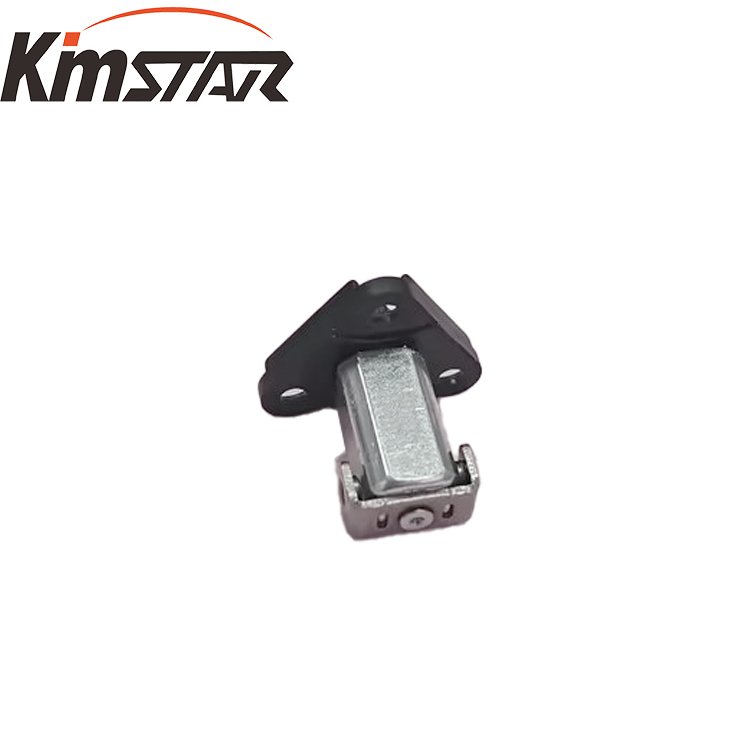
3、 Detailed technical implementation plan
(1) Material selection and processing technology
The core of material selection is to balance high strength, lightweight, and shock absorption performance, while improving environmental adaptability and durability. The specific selection and processing technology are as follows:
- Axis material: Made of aviation grade high-strength alloy steel (20CrMnTi) and 65Mn spring steel composite material, balancing rigidity and toughness, with a tensile strength of ≥ 1200MPa. After carburizing and quenching treatment, the surface hardness reaches HRC58-62, and the wear resistance is improved by 30%. At the same time, a hollow shaft structure design is adopted, which reduces weight by 15% while ensuring strength, reduces aircraft load, and helps improve drone endurance;
- Damping medium: High temperature resistant silicone oil (temperature resistance -40 ℃~85 ℃) is selected, with stable viscosity coefficient, no solidification or loss, ensuring stable damping torque under different temperature environments. At the same time, it has good lubrication performance, reduces internal component wear, and extends the service life of the shaft;
- Friction pad material: Copper based powder metallurgy friction pads are used, combined with self-lubricating coating (polytetrafluoroethylene), with a stable friction coefficient (0.15-0.2), no jamming or abnormal noise, and can withstand more than 10000 times of friction without obvious wear. The torque attenuation rate is ≤ 10%, solving the pain points of traditional friction pads that are prone to wear and damping failure;
- Surface treatment: The shaft body is treated with nickel plating and passivation (film thickness of 5 μ m), and there is no corrosion after 500 hours of salt spray testing. It is suitable for harsh environments such as humidity and salt spray; The damping chamber is treated with anodizing to improve sealing and corrosion resistance, prevent leakage of damping medium, and ensure long-term stability of shock absorption performance.
(2) Structural design details
Based on the shock absorption requirements of different parts of the drone, a differentiated structural design is adopted to ensure that the damping shaft is perfectly adapted to the drone body, gimbal, and arm, while maximizing the shock absorption effect. The specific structural design is as follows:
1. gimbal damping shaft structure
In response to the shock absorption requirements of pan tilt photography, a dual damping plate+spiral spring pre tensioning structure is adopted to achieve adjustable damping torque of 0.1N · m-10N · m, with a control accuracy of ≤± 3%. It supports 360 ° infinite rotation and hovering at any angle, with a positioning accuracy error of ≤ 1 °, to avoid dragging of pan tilt images caused by vibration. The shaft is equipped with dual O-ring fluororubber seals, achieving IP67 waterproof and dustproof performance, preventing rainwater and dust from entering the interior and affecting damping performance; Simultaneously design a spiral oil channel (groove length 50-100mm, pitch 0.5-1mm) to ensure uniform distribution of damping medium, improve the stability of damping torque, and adapt to unmanned aerial vehicle gimbal usage scenarios such as consumer level aerial photography and industrial level inspection.
2. Arm damping shaft structure
To address the issue of arm vibration transmission, a flexible buffering+multi damping layer structure is adopted, and elastic buffering components (made of silicone material) are added to absorb low-frequency vibrations generated by the body motor, with a vibration transmission rate of ≤ 15%; The shaft body adopts an integrated molding process to reduce assembly errors, with a coaxiality of ≤ 0.005mm, to avoid eccentric vibration during arm rotation. Simultaneously supporting arm folding function, the folding angle can be customized (0 ° -180 °), and a limit structure is designed at the folding point to prevent component damage caused by excessive rotation. The damping torque is adapted to the arm load (5N · m-50N · m), balancing shock absorption effect and arm support stability, suitable for folding unmanned aerial vehicles, crop protection unmanned aerial vehicles and other models.
3. Damping shaft structure of landing gear
In response to the impact damping requirements of landing gear, a hydraulic damping+elastic buffering composite structure is adopted, which can effectively absorb the instantaneous impact vibration during landing and reduce the damage to the core components of the fuselage caused by the impact; The damping torque can be dynamically adjusted according to the load of the landing gear to ensure a smooth landing. At the same time, the angle limit (0 ° -90 °) is designed to ensure stable support for the fuselage after the landing gear is deployed. The shaft body is made of high-strength aluminum alloy material, further lightweight, and has good impact resistance, suitable for multi terrain landing scenarios (grassland, mountain, hard ground), improving the safety of drone landing.
(3) Damping control technology
Adopting precise damping control technology to achieve precise adjustment and dynamic adaptation of damping torque, ensuring shock absorption effect under different flight conditions. The specific technical implementation is as follows:
- Precise torque control: Through self-developed precision spring and damping plate combination structure, combined with German DMG five axis machining center precision machining, the damping torque control accuracy is improved to ± 3%, far exceeding the industry standard of ± 5%. The damping torque can be accurately adjusted according to the damping needs of different parts of the drone, avoiding the problem of "too tight or too loose damping failure";
- Dynamic adaptive adjustment: equipped with a micro torque sensor, real-time collection of shaft vibration data and torque changes, automatically adjusting damping torque through a microcontroller control module, adapting to different flight conditions (such as increasing damping during high-speed flight and decreasing damping during hovering), ensuring a balance between shock reduction effect and operational flexibility, while linking with the flight control system to achieve coordinated attitude stability;
- Dynamic balance calibration: Before leaving the factory, each damping shaft undergoes a full inspection using a Japanese Sanfeng dynamic balance tester to ensure no eccentric vibration during high-speed rotation. The dynamic balance accuracy reaches G2.5 level, completely solving the vibration interference caused by the shaft's own rotation and further improving the shock absorption effect;
- Angle positioning control: Using a combination of gear limit and damping feedback, it achieves precise positioning at any angle with a positioning accuracy error of ≤ 1 °. It supports customized fixed angle limits such as 45 °, 90 °, and 180 °, and is suitable for different usage needs such as pan tilt adjustment and arm folding, avoiding angle drift caused by vibration.
(4) Production and Quality Control Standards
To ensure the stability and consistency of the performance of the damping shaft, the following production and quality control standards are strictly followed to achieve full process quality control:
- Production process: Adopting automated production lines to achieve the integration of shaft processing, damping assembly, sealing treatment and other processes, reducing manual assembly errors; Key processes such as five axis machining and damping debugging are controlled by dedicated personnel to ensure machining accuracy and assembly quality. The journal and shaft sleeve are precision ground with a surface roughness Ra ≤ 0.8 μ m to ensure smooth and burr free mating surfaces;
- Quality control testing: Establish a three-level quality control system, including raw material entry testing (material hardness, viscosity, corrosion resistance), production process testing (processing accuracy, assembly clearance, damping torque), and finished product factory testing (vibration transmission rate, dynamic balance, environmental adaptability). The sampling and testing ratio for each batch of products should be ≥ 10%, and all non-conforming products should be reworked;
- Environmental testing: The finished product needs to undergo high and low temperature testing (-40 ℃~85 ℃, continuous for 72 hours), salt spray testing (500 hours), waterproof and dustproof testing (IP67), and lifespan testing (20000 rotations/folds, torque attenuation rate ≤ 10%) to ensure stable operation in harsh environments;
- Standard compliance: The product complies with ISO9001 and IATF16949 quality system certifications, and the damping medium meets RoHS environmental standards. It is compatible with technical specifications in the domestic and international drone industry and can meet market demands in different regions.
4、 Adaptation scenarios and customized solutions
(1) Adaptation scenario
The damping shaft designed in this technical solution can be widely adapted to various drone scenarios, covering multiple fields such as consumer, industrial, and plant protection. The specific adaptation scenarios are as follows:
- Consumer grade drone: gimbal shock absorption, arm folding, suitable for aerial photography, selfies and other scenes, ensuring clear and stable shooting images and smooth operation;
- Industrial grade unmanned aerial vehicles: inspection, surveying, and security unmanned aerial vehicles with gimbal, boom, and landing gear shock absorbers, suitable for high-altitude and complex airflow environments, ensuring flight control accuracy and equipment reliability;
- Plant protection drone: Arm and landing gear shock absorption, adapted to complex terrain in the field, reduces vibration interference during pesticide spraying, improves spraying uniformity, and resists erosion from humid and dusty environments in the field;
- Special unmanned aerial vehicles: shock absorption for unmanned aerial vehicles in extreme environments such as high temperature, low temperature, and high altitude, such as high-altitude inspection and polar exploration drones, to ensure that the shaft can still stably play a shock absorption role in extreme environments.
(2) Customized solution
We provide customized services throughout the entire process to meet the differentiated needs of different drone models and parts. The specific customization content is as follows:
- Structural customization: Based on the size of the drone gimbal, arm structure, and landing gear load, customize the shaft size and structural form (hollow/solid, single damping/double damping), support special functional designs such as hollow wire passing and angle limit, and adapt to the overall structure of the drone;
- Performance customization: Customize the damping torque range, vibration transmission rate, and temperature adaptation range according to the requirements of the flight scenario. For example, choose high-temperature resistant damping media in high-temperature environments and use high torque damping structures for heavy-duty drones;
- Process customization: Based on customer needs, customize surface treatment processes (nickel plating, anodizing, passivation), sealing levels (IP67 and above), and adapt to different environmental usage requirements;
- Rapid response: equipped with a professional research and development team to support the direct import of 3D drawings into production, and 72 hour rapid proofing. The mold development cycle has been shortened to 15 days, 50% faster than the industry average. It adapts to the rapid iteration needs of UAVs, and provides technical support and after-sales commissioning services.
5、 Advantages and core values of the solution
(1) Advantages of the plan
- Outstanding shock absorption effect: full frequency vibration attenuation (10Hz-2000Hz), vibration transmission rate ≤ 15%, effectively solving problems such as blurred image and flight control interference caused by drone flight vibration. Compared with traditional damping shafts, the shock absorption accuracy is improved by 40%;
- Strong stability: damping torque control accuracy ≤ ± 3%, wide temperature range adaptation (-40 ℃~85 ℃), waterproof and dustproof IP67, no rust after 500 hours of salt spray testing, torque attenuation rate ≤ 10%, ensuring long-term high-frequency flight stability and reliability, with a lifespan twice the industry average level;
- Lightweight design: using hollow shafts and aviation grade lightweight materials, the weight is reduced by 15%, reducing the body load and helping the drone improve its endurance. At the same time, it also considers high strength and can withstand impact loads during high-speed maneuvering;
- Customization flexibility: supports multi model and multi part adaptation, fast prototyping and mold development, can meet the differentiated needs of different customers, and adapt to the fast iteration rhythm of drones;
- Cost controllable: Automated production reduces labor costs, long-lasting and durable design reduces maintenance costs, while optimizing material and process selection to achieve a balance between performance and cost, with cost-effectiveness far exceeding similar products in the industry.
(2) Core values
- Improving flight safety: effectively attenuating vibrations, suppressing fuselage resonance, reducing interference from flight control systems, reducing the risk of flight loss caused by vibrations, ensuring the safety of drone flight, especially adapting to the operational requirements in complex flight environments;
- Optimize shooting and operation effects: reduce gimbal vibration, ensure clear and unobstructed shooting images, improve the accuracy and efficiency of aerial photography, surveying and other operations, while reducing vibration damage to the core components of the drone and extending the service life of the entire machine;
- Adapting to diverse scenarios: covering consumer, industrial, and special drones, capable of handling extreme environments such as high and low temperatures, humidity, and salt spray, expanding the application range of drones and helping the drone industry upgrade towards high-end and diversified development;
- Empowering customer innovation: Flexible customized services help customers quickly launch drone products that meet market demand, shorten research and development cycles, enhance product competitiveness, and provide full process technical support to reduce customer research and development costs.
6、 After sales guarantee and technical support
To ensure the implementation effect of the plan, provide comprehensive after-sales support and technical assistance services, and fully escort customers to use:
- Quality assurance: The product is guaranteed for 1 year. During the warranty period, if there is non-human damage (such as damping failure, structural deformation, rust, etc.), free repair or replacement will be provided, and lifetime maintenance services will be provided;
- Technical support: Equipped with a professional technical team, providing full process technical services such as solution consultation, customized design, installation and debugging, timely solving technical problems encountered by customers during use, with a response time of ≤ 24 hours;
- Iterative upgrade: Based on the technological development of the drone industry and customer needs, continuously optimize the damping shaft technology solution, provide product upgrade services, and ensure that the solution always adapts to the cutting-edge needs of the industry;
- Batch supply: With the ability to produce on a large scale, it can meet the needs of customers for bulk orders, ensuring a stable supply cycle (7-15 days for regular orders and 15-30 days for customized orders), while ensuring consistent product quality.
- This technical solution achieves efficient shock absorption, stable reliability, and flexible adaptation of the damping shaft through precise material selection, optimized structural design, and strict quality control standards. It can effectively solve the core pain points of vibration interference during drone flight, provide core support for improving the overall performance of drones, and help promote the high-quality development of the drone industry.
AfterSalesService :
Key words:
More Products