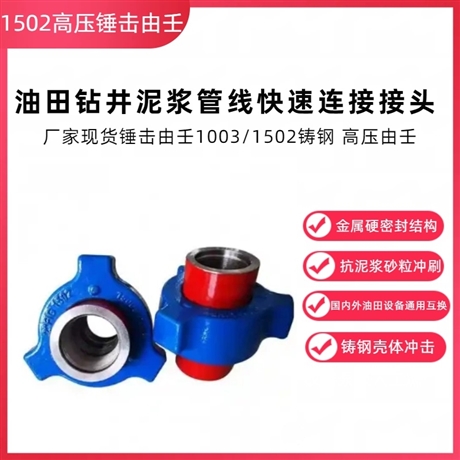

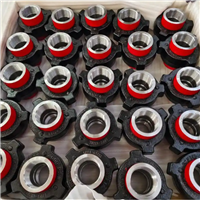
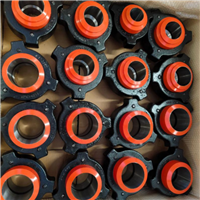
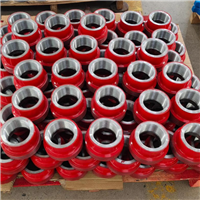
1502 Hammer Strike with Three Claws Forging High Pressure Oilfield Mud Pipeline Welding Joint
Category:
hardware/Pneumatic tools/Pneumatic hammer
Model:
one thousand five hundred and two
Brand:
Hengshui Xinghai
work pressure:
10000-15000 psi
connection method:
Three claw hammer locking
manufacturing process:
Whole forging
Surface Treatment:
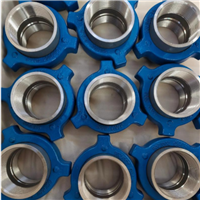
Red and blue spray coating
Applicable Medium:
Oilfield mud, high-pressure fluid
sealing form:
O-ring seal
Execution Standard:
API Spec 6A
Detection method:
Ultrasonic testing, hydrostatic testing
Retail Price
10,000,000.00USD
重量
kg
- Product Description
-
work pressure 10000-15000 psi
connection method Three claw hammer locking
manufacturing process Whole forging
Surface Treatment Red and blue spray coating
Applicable Medium Oilfield mud, high-pressure fluid
sealing form O-ring seal
Execution Standard API Spec 6A
Detection method Ultrasonic testing, hydrostatic testing
Description :
The 1502 hammer joint is a quick connecting pipe designed specifically for high-pressure fluid transportation, mainly used to solve the problems of frequent disassembly and high-pressure sealing of mud pipelines in oilfield drilling, fracturing, and cementing operations. The typical working conditions of this category include high vibration, high impact, and harsh environments containing particulate media. Through a three jaw locking structure, rapid docking and disassembly are achieved, significantly reducing construction downtime. As the core component of high-pressure union joints, its design pressure usually covers the range of 10000psi to 15000psi, suitable for oil and gas extraction and large-scale industrial cleaning equipment. The 1502 hammer joint, with its excellent anti fatigue performance, has become a key connecting node in the mud pump outlet, riser, and high-pressure manifold system, ensuring stable fluid transmission under extreme working conditions. In terms of specifications, the main body of the 1502 hammer striking union is forged from high-quality alloy steel and undergoes quenching and tempering heat treatment to enhance material strength and toughness, in compliance with API Spec 6A or relevant petroleum industry standards. Common diameter sizes include 2 inches, 3 inches, 4 inches, etc., with standard threaded interfaces to ensure compatibility with existing pipeline systems. Surface treatment usually adopts the red blue spraying process, where red represents high pressure warning and blue indicates product specifications or flow direction, while providing anti-corrosion protection. The joint of the welding joint adopts full penetration welding technology, and the weld seam undergoes ultrasonic testing to ensure that there are no defects such as cracks and pores. Each 1502 hammer joint undergoes strict hydrostatic testing before leaving the factory to verify its sealing integrity under rated working pressure, with dimensional tolerances controlled within the precision machining standard range.
When selecting, it is necessary to clarify the working pressure level and medium characteristics. The 1502 model specifically refers to the union series with a specific pressure level and connection size, which is suitable for high-pressure mud pipelines that require high-frequency disassembly and assembly. If the operating pressure is below 10000 psi and the vibration is small, low-pressure unions or flange connections can be considered to reduce costs; If the medium is highly corrosive, special materials such as stainless steel or an inner lining anti-corrosion layer should be specified. Compared with clamp type joints, the 1502 hammer joint has higher pressure bearing capacity and pull-out resistance, but it is heavier and requires specialized hammer tools or hydraulic assistance during installation. The purchaser should verify the interface thread standards (such as NPT, BSP) and sealing material (such as nitrile rubber, polyurethane) to ensure compatibility with existing pipelines on site and avoid leakage or connection failure due to non-compliance with specifications.
When installing the 1502 hammer joint, it is necessary to clean the sealing surface and O-ring groove, apply an appropriate amount of lubricating grease to reduce friction and protect the seal. Use a specialized hammer to evenly tap the three jaw locking ring until a crisp metal impact sound is heard, indicating that the locking is in place. It is strictly prohibited to use non-standard tools to violently tap and cause deformation. In daily maintenance, it is recommended to regularly check the aging condition of the seals and whether there are cracks or severe wear on the body, especially under high-pressure pulse conditions. It is recommended to conduct a comprehensive flaw detection test every drilling cycle completed. Common faults include leakage caused by scratches on the sealing surface, in which case it is necessary to grind and repair or replace the sealing components; If deformation or thread slippage of the three claws is found, the 1502 hammer joint should be immediately stopped and replaced with a new one. It is strictly prohibited to operate with defects to ensure the safe operation of the oilfield mud pipeline system.
AfterSalesService :
Key words:
More Products