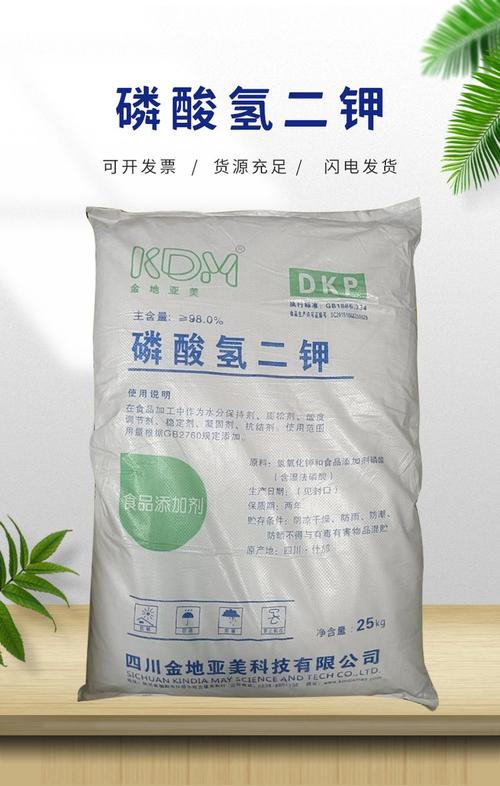

Potassium dihydrogen phosphate national standard food grade feed grade high-purity white crystalline powder
Category:
chemical industry/inorganic salt/Phosphorus compounds and phosphates
Model:
National Standard
Brand:
Ding Xin
execution standard:
GB 25561-2010
content:
≥98.0%
loss on drying:
≤2.0%
water-insoluble substance:
≤0.2%
Heavy metals (calculated as Pb):
≤0.0005%
Arsenic (calculated as As):
≤0.0003%
Fluoride (calculated as F):
≤0.005%
appearance:
White crystal or powder
PH value (10g/L solution):
8.5-9.5
Packing Specification:
25kg/bag
Retail Price
10,000,000.00USD
重量
kg
- Product Description
-
execution standard GB 25561-2010
content ≥98.0%
loss on drying ≤2.0%
water-insoluble substance ≤0.2%
Heavy metals (calculated as Pb) ≤0.0005%
Arsenic (calculated as As) ≤0.0003%
Fluoride (calculated as F) ≤0.005%
appearance White crystal or powder
PH value (10g/L solution) 8.5-9.5
Packing Specification 25kg/bag
Description :
Potassium dihydrogen phosphate is an important inorganic salt product widely used in the fields of food additives, feed additives, and industrial buffering agents. It mainly solves the problems of pH regulation, metal ion chelation, and nutrient enhancement in food processing, and is also an important component of microbial culture media. Under typical operating conditions, dipotassium hydrogen phosphate exists in the form of white crystals or crystalline powders, and is easily soluble in water. The aqueous solution is alkaline. As a national standard product, its purity usually reaches over 98%, which can effectively meet the high requirements of the food industry for safety and stability. It is an indispensable functional additive in brewing, dairy and meat processing.
This product strictly complies with the national standard GB 25561-2010 "National Food Safety Standard for Food Additives - Potassium dihydrogen phosphate" or relevant feed grade standards. The appearance is white granules or crystalline powder, odorless, and has a salty and cool taste. Its main physical and chemical indicators include: content of dipotassium hydrogen phosphate (K2HPO4) ≥ 98.0%, drying loss ≤ 2.0%, insoluble matter ≤ 0.2%, heavy metals (calculated as Pb) ≤ 0.0005%, arsenic (calculated as As) ≤ 0.0003%, fluoride (calculated as F) ≤ 0.005%. The production process usually adopts the neutralization reaction of thermal phosphoric acid and potassium hydroxide, and is made through processes such as filtration, concentration, crystallization, centrifugal separation, and drying. Product packaging often uses woven bags or paper bags lined with polyethylene plastic bags, with a net weight of 25kg per bag. They should be stored in a cool, ventilated, and dry place to prevent moisture and clumping.
When selecting, it is necessary to clearly distinguish between food grade, feed grade, and industrial grade dipotassium dihydrogen phosphate. Food grade pH regulators and stabilizers suitable for beverages, milk powder, chocolate and other foods; Feed grade is mainly used as a phosphorus and potassium supplement and buffering agent in animal feed; Industrial grade is used in fields such as electroplating, printing and dyeing, and water treatment. If purchased for human ingestion or animal feeding, corresponding production licenses and batch testing reports must be requested to ensure that the limits of heavy metals and harmful substances comply with national standards. For application scenarios that require high dissolution rates or specific particle sizes, attention should be paid to the particle size distribution and dissolution time indicators of the product, avoiding the selection of products containing excessive fine powder or severe agglomeration to ensure feeding uniformity and production efficiency.
During the use of dipotassium dihydrogen phosphate, attention should be paid to operating procedures. Although its toxicity is low, dust may cause irritation to the respiratory tract. It is recommended to wear a dust mask for operation. When installing or using, there are no special equipment requirements. Simply mix the water phase or dry powder in proportion. The focus of daily maintenance is on controlling the humidity of the storage environment. As it has a certain degree of moisture absorption, it should be sealed in a timely manner after opening to avoid long-term exposure to air that may cause deliquescence or clumping, affecting the accuracy of use. Common malfunctions such as solution turbidity are usually caused by high water hardness or the presence of trace amounts of insoluble substances in the product, which can be resolved through filtration or the use of deionized water. Regularly inspect the packaging integrity of inventory products to prevent damage and contamination, ensuring stable product quality.
AfterSalesService :
Key words:
More Products