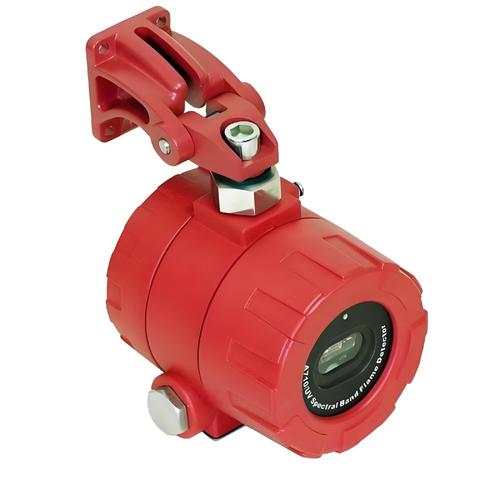

Industrial flame detectors quickly respond to fire warnings and are suitable for flammable and explosive environments
Category:
Security/Fire protection system/Fire detection
Model:
HK-6802A
Brand:
Huikong Electronics
Detection principle:
UV/Infrared/Composite
detection range:
30-60 meters
Detection angle:
90°-120°
Working voltage:
DC24V
Protection rating:
IP65
response time:
<5 seconds
signal output:
Relay/RS485
Operating temperature:
-40℃~+70℃
Retail Price
10,000,000.00USD
重量
kg
- Product Description
-
Detection principle UV/Infrared/Composite
detection range 30-60 meters
Detection angle 90°-120°
Working voltage DC24V
Protection rating IP65
response time <5 seconds
signal output Relay/RS485
Operating temperature -40℃~+70℃
Description :
Flame detector is an optical sensing device specifically used to monitor flame radiation in the environment, mainly solving the problems of delayed detection and high false alarm rate in the early stage of fire in industrial production and storage scenarios. It detects specific wavelengths of ultraviolet or infrared radiation emitted by flames and sends out alarm signals in the very early stages of a fire. Typical working conditions include high-risk areas such as petroleum and petrochemical storage tank areas, chemical plant reactor areas, large warehouses, and gas boiler rooms. This device can work stably in complex lighting and high temperature environments, providing key triggering signals for fire linkage systems, effectively ensuring personnel safety and property integrity, and is an indispensable front-end sensing component in modern industrial fire safety systems.
This flame detector usually adopts a sturdy explosion-proof shell design, with a protection level of IP65 or above, which can resist the erosion of dust, rainwater, and corrosive gases. The core sensor components have high sensitivity, with detection angles typically between 90 degrees and 120 degrees, and effective detection distances ranging from 30 meters to 60 meters depending on the model. The product complies with national fire safety standards such as GB15631 "Special Fire Detectors", and some high-end models have passed CCCF fire product certification and ATEX explosion-proof certification. The working voltage is generally DC24V, with a power consumption of less than 3W. The signal output supports relay switch values or RS485 communication interfaces, adapting to the access requirements of various fire alarm control hosts and ensuring real-time and accurate data transmission.
When selecting, it is necessary to choose ultraviolet, infrared, or composite flame detectors based on the potential types of fire sources on site. Purple exterior is suitable for flames generated by the combustion of carbon containing substances and is sensitive to interference such as arc welding; Infrared type is suitable for oil and gas combustion, with strong anti-interference ability but slightly slower response; The composite type combines the advantages of both and is suitable for places that require extremely high reliability. Not suitable for scenarios with a large number of obstructions or non open flame smoldering fires. If there is strong direct sunlight or high-frequency electromagnetic interference on site, a model with corresponding filtering algorithms and shielding design should be selected, and attention should be paid to installation height and angle to avoid blind spots and ensure that the detection coverage area is free of blind spots.
When installing, the flame detector should be fixed on a stable bracket, with the lens facing the protected area, avoiding direct exposure to strong light sources or heat sources. It is recommended to perform a quarterly appearance cleaning for daily maintenance, using a soft cloth to wipe away dust and oil stains on the surface of the lens to prevent a decrease in sensitivity. Every six months, specialized test lights or simulated fire sources need to be used for functional testing to verify whether the alarm signal is properly uploaded to the control host. Common faults include false alarms or missed alarms caused by lens contamination, and communication interruptions caused by poor line contact. Regularly checking the tightness of the wiring terminals can significantly reduce the failure rate and ensure that the equipment is in a good state of readiness for the long term.
AfterSalesService :
Key words: