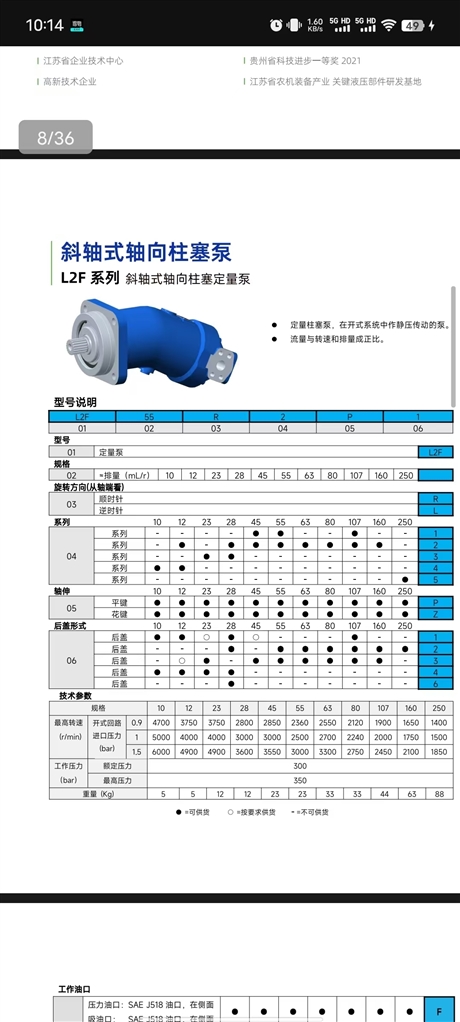

L2F series inclined axis axial piston pump high-pressure and high flow hydraulic power source
Category:
mechanical equipment/pump/Plunger pump
Model:
L2F
Brand:
Turner Hydraulic
structural form:
Oblique axis type
rated pressure:
35 MPa
Peak pressure:
40 MPa
Drive Type:
Mechanical Drive
Media requirements:
Mineral hydraulic oil
Installation Method:
Flange Installation
Control method:
Manual/Hydraulic Variables
Operating temperature:
-20℃~80℃
Retail Price
10,000,000.00USD
重量
kg
- Product Description
-
structural form Oblique axis type
rated pressure 35 MPa
Peak pressure 40 MPa
Drive Type Mechanical Drive
Media requirements Mineral hydraulic oil
Installation Method Flange Installation
Control method Manual/Hydraulic Variables
Operating temperature -20℃~80℃
Description :
The L2F series inclined axis axial piston pump is a positive displacement hydraulic pump that mainly solves the problems of low power transmission efficiency and large pulsation in hydraulic systems under high pressure conditions. The pump converts the rotational motion of the drive shaft into the reciprocating motion of the plunger through an inclined shaft structure, thereby achieving oil suction and discharge. Typical operating conditions include construction machinery walking drive, industrial hydraulic station main pump source, and ship deck machinery drive. Its core advantage lies in its ability to withstand high working pressure, usually with a rated pressure of over 35MPa and a higher peak pressure. It is suitable for heavy-duty starting and continuous high load operation scenarios and is a key power component in hydraulic systems.
In terms of specifications and processes, the L2F series inclined shaft axial piston pump adopts high-strength cast iron or cast steel housing, and the internal friction pairs such as plunger and cylinder body are usually precision ground and matched to ensure good sealing and wear resistance. The implementation standard refers to GB/T 7935 General Technical Conditions for Hydraulic Components and JB/T related industry standards. The common displacement range covers from tens of milliliters per revolution to hundreds of milliliters per revolution, depending on the model specifications. The pump body design has standard flange installation interfaces and shaft extension forms, making it easy to connect with motors or engines. Some models are equipped with built-in oil replenishment pumps or flushing valves to improve lubrication conditions and cooling effects, ensuring stable operation in high temperature and high pressure environments.
When selecting, it is necessary to clarify the required working pressure, flow requirements, and driving speed of the system. The L2F series inclined axis axial piston pump is suitable for both closed loop and open loop systems, especially for situations that require bidirectional variable adjustment. Compared with the straight axis plunger pump, the inclined axis structure allows for a larger swing angle, thus often providing larger displacement and higher speed limit under the same volume. If there are a large number of impurities or pollution risks in the working conditions, a high-precision filter needs to be pre installed. Not suitable for indoor light load environments that are extremely sensitive to noise and have no sound insulation measures. In this case, blade pumps or gear pumps can be considered as alternatives.
During installation, it is necessary to ensure that the coaxiality error between the pump shaft and the drive shaft is within the allowable range. It is usually required to use an elastic coupling and strictly align it to avoid direct radial force acting on the pump shaft, which may cause early bearing failure. Before the initial start-up, the pump housing must be filled with clean hydraulic oil, and dry running without oil is strictly prohibited. The focus of daily maintenance is to monitor the degree of oil contamination, working temperature, and abnormal noise. It is recommended to replace the hydraulic oil and clean the filter element every 2000 hours of operation. Common faults include slow pressure establishment, insufficient flow, or excessive leakage, often caused by increased internal leakage, intake of air, or wear of the distribution plate. Damaged components need to be disassembled, inspected, and replaced in a timely manner.
AfterSalesService :
Key words: