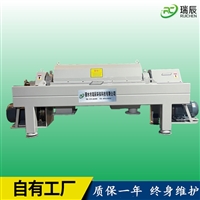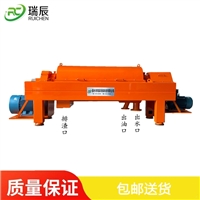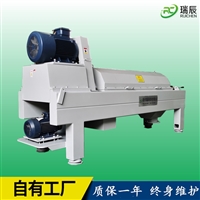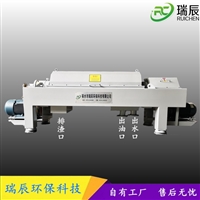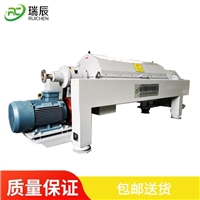
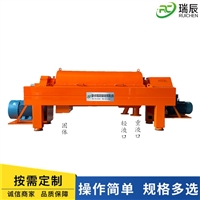
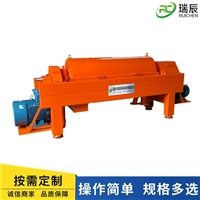
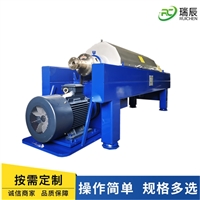
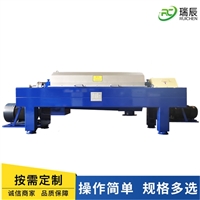
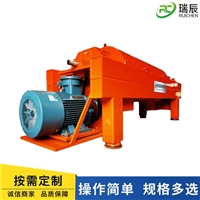
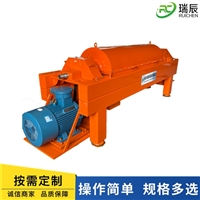
Crude oil refining three-phase centrifuge automated oil-water slag three-phase separation equipment
Category:
mechanical equipment/Separation equipment/centrifuge
Model:
WLs-350
Brand:
Ruichen Environmental Protection
model:
WLs-350
Installation method:
horizontal
Unloading method:
Spiral discharge centrifuge
Filter form:
Settlement type
Range of maximum separation factor Fr values:
Constant speed centrifuge
Inner diameter of drum:
three hundred and fifty
Drum length:
one thousand three hundred and fifty
Drum speed:
three thousand and five hundred
Motor power:
fifteen
Processing & Customization:
No
Separation factors:
3620 grams
Loading limit:
3-6m3/h
degree of automation:
fully automatic
purpose:
industrial use
weight:
two thousand and one hundred
Place of Origin:
Lishui City, Zhejiang Province
manufacturer:
Lishui Ruichen Environmental Protection Technology Co., Ltd
Retail Price
215,600.00USD
重量
kg
- Product Description
-
model WLs-350
Installation method horizontal
Unloading method Spiral discharge centrifuge
Filter form Settlement type
Range of maximum separation factor Fr values Constant speed centrifuge
Inner diameter of drum three hundred and fifty
Drum length one thousand three hundred and fifty
Drum speed three thousand and five hundred
Motor power fifteen
Processing & Customization No
Separation factors 3620 grams
Loading limit 3-6m3/h
degree of automation fully automatic
purpose industrial use
weight two thousand and one hundred
Place of Origin Lishui City, Zhejiang Province
manufacturer Lishui Ruichen Environmental Protection Technology Co., Ltd
Description :
Crude oil refining three-phase centrifuge automated oil-water slag three-phase separation equipment
The three-phase centrifuge is a continuous, enclosed, and automated equipment that completes the separation process without causing blockages. It does not require high-pressure water to flush the interior of the machine during operation, resulting in high production efficiency. It is capable of completing automated oil-water slag three-phase separation processes such as solid-phase dehydration, liquid-phase clarification, liquid-liquid solid, liquid-solid three-phase separation, and particle size classification.
Working principle and structure
After two liquid phases and one solid phase enter the centrifuge, they are expanded thousands of times by the centrifugal force field. The solid phase is settled under the action of centrifugal force, and the two liquid phases also separate into layers, thus achieving solid-liquid three-phase separation, and are discharged from the body under the action of special mechanisms. The entire feeding and separation process is continuous, closed, and automated.
It is mainly composed of components such as drum, screw, differential, frame, housing, and motor. The drum adopts a double cone angle design, and the inner wall of the drum is specially designed with longitudinal concave convex grooves to improve the efficiency of spiral conveying of solid phase. The working surface of the spiral blade has a hard alloy protective layer, which effectively improves the wear resistance life of the spiral blade. The main motor is controlled by the main frequency converter, and the auxiliary motor is controlled by the auxiliary frequency converter. The frequency of the motor can be adjusted arbitrarily. The power supply of the auxiliary frequency converter is provided by the main frequency converter, known as DC common bus power supply. DC common bus power supply realizes energy feedback when the auxiliary motor is in the working state of the generator, which can effectively save electricity.
When the material to be separated is transported by the feed pump to the centrifuge drum, the high-speed rotating drum generates strong centrifugal force to settle solid particles with higher density than the liquid phase onto the inner wall of the drum. Due to the different rotational speeds of the screw and the drum, there is relative motion between the two (i.e., adjustable speed difference), and the solid (slag) with higher density settles onto the drum wall. Two phases of clear liquid with different densities form concentric cylinders, with the lighter liquid phase in the inner layer and the heavier liquid phase in the outer layer. The thickness of different liquid rings can be adjusted by adjusting the liquid plate (i.e. the water content in the oil or the oil content in the water can be adjusted). The slag deposited on the wall of the rotary drum is transported by the screw conveyor to the cone end of the rotary drum, and discharged into the solid material tank from the discharge port. Water and oil are discharged from their respective outlets, and the entire three-phase separation process of oil, water, and slag is automatically fed and discharged.

AfterSalesService :
Key words:- Crude oil refining three-phase centrifuge
More Products