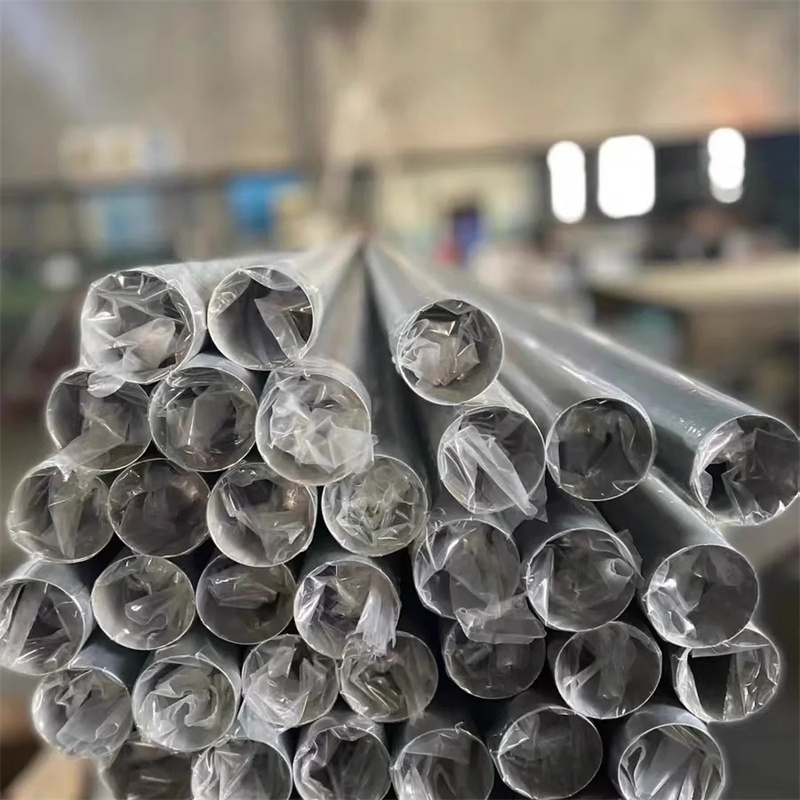

304 stainless steel decorative tube mirror brushed polished for indoor and outdoor guardrails and handrails
Category:
building materials/Construction and building materials pipes/Stainless steel pipe
Model:
4-219
Brand:
Shuo Kai
Material:
304/201
surface process:
Mirror/brushed
shape:
Round tube/square tube/rectangular tube
Wall thickness range:
0.4-2.0mm
Execution Standard:
GB/T 12770
Place of Origin:
Zibo, Shandong
Application Scenarios:
Guardrails/handrails/decorations
Corrosion resistance:
good
Retail Price
10,000,000.00USD
重量
kg
- Product Description
-
Material 304/201
surface process Mirror/brushed
shape Round tube/square tube/rectangular tube
Wall thickness range 0.4-2.0mm
Execution Standard GB/T 12770
Place of Origin Zibo, Shandong
Application Scenarios Guardrails/handrails/decorations
Corrosion resistance good
Description :
Stainless steel decorative pipe is a hollow pipe mainly used for building decoration, furniture manufacturing, and mechanical structure surfaces. It solves the problem of traditional iron pipes being prone to rusting and rough appearance, providing a high gloss or matte texture surface effect, suitable for indoor decoration, stair handrails, guardrails, and display racks with high aesthetic requirements. This type of product is usually made of austenitic stainless steel material, which has good corrosion resistance and formability, and can adapt to humid environments or mild outdoor exposure scenarios. It is an indispensable basic material in modern building decoration engineering.
The specifications of this stainless steel decorative tube include various cross-sectional shapes such as round tube, square tube, and rectangular tube. The common outer diameter range is from 9.5mm to 114mm, and the wall thickness is usually between 0.4mm and 2.0mm. Surface treatment processes include mirror finish (8K), wire drawing (HL), sandblasting, and titanium plating, etc., in accordance with relevant national standards such as GB/T 12770 or GB/T 12771. The materials are mainly 304 and 201, and 316L is used in some high-end scenarios. The product needs to pass water pressure testing, flattening testing, and intergranular corrosion testing to ensure that it does not crack or deform during processing and bending, and the surface is free of scratches, sand holes, or depressions, meeting the environmental protection and quality certification requirements of building decoration materials.
When selecting, it is necessary to clarify the usage environment to determine the material grade: 201 material can be selected for indoor dry environments to reduce costs, while 304 and above materials are recommended for coastal areas, outdoor or high humidity environments to prevent rust and corrosion. The key to distinguishing decorative pipes from industrial fluid pipes lies in wall thickness tolerances and surface standards. Decorative pipes focus more on surface smoothness and dimensional accuracy rather than pressure bearing capacity. If used for load-bearing structures, it is necessary to calculate the wall thickness and support spacing to avoid insufficient strength caused solely by appearance selection. For special color requirements such as black titanium, rose gold, etc., it is necessary to confirm the adhesion of the coating and the fingerprint resistant treatment process to ensure convenient maintenance in the later stage.
When installing stainless steel decorative pipes, it is recommended to use specialized cutting tools to avoid burrs on the cut. During welding, argon arc welding should be used in conjunction with protective gas to prevent oxidation and blackening of the weld seam. After welding, polishing treatment should be carried out to maintain overall consistency. Daily maintenance only requires wiping surface dust and stains with neutral cleaning agents, avoiding the use of strong acid and alkali cleaning agents to damage the passivation film. Common faults include surface rust, which is often caused by residual iron powder during construction or excessive chloride ions in the environment. It can be removed with stainless steel specific cleaning paste. Regularly check for loose connections, especially in areas with high vibration, to ensure structural stability and long-lasting appearance.
AfterSalesService :
Key words:
More Products