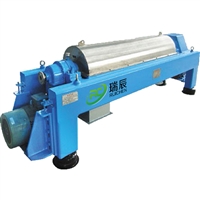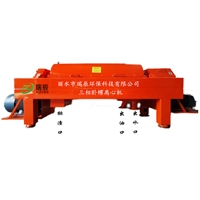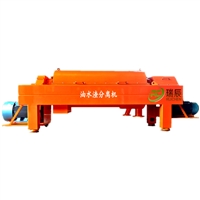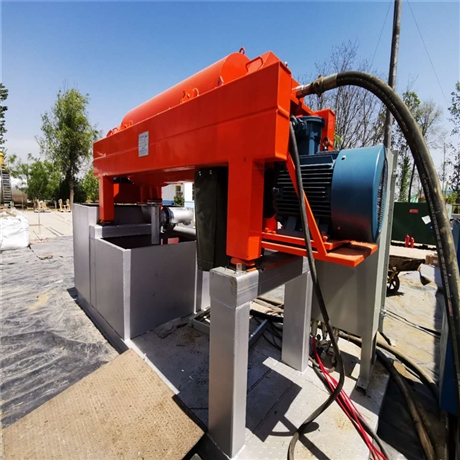

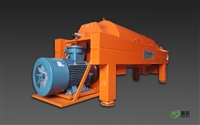
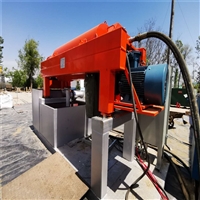
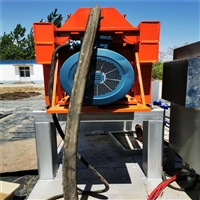
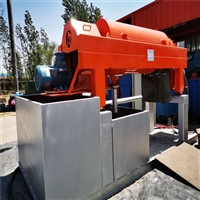
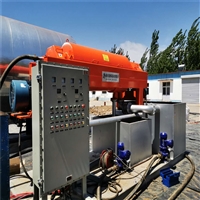
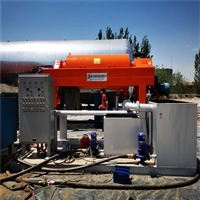
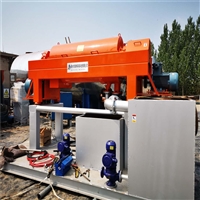
Manufacturer wholesale oil-water separation equipment three-phase horizontal screw centrifuge
Category:
Environmental Protection/Sludge treatment machinery/Horizontal spiral centrifuge
Model:
RCSWL435
Brand:
Ruichen Environmental Protection
Retail Price
56,000.00USD
重量
kg
- Product Description
-
Description :
Manufacturer wholesale oil-water separation equipment three-phase horizontal screw centrifuge
Solid waste containing oil, known as oily sludge, is generated during oil extraction, transportation, refining, oily wastewater treatment, and tank cleaning. It generally has an oil content of 10% to 50% and a water content of about 40% to 90%, and is characterized by high oil content and heavy oil components. Oily sludge is a large and widespread source of pollution, containing pathogens, parasites (eggs), heavy metals, salts, as well as toxic and harmful substances such as dioxins and radioactive nuclides that are difficult to degrade. At present, in China's petrochemical industry, an average of 800000 tons of tank sediment and pond sediment are generated annually. The large-scale production of oily sludge has a growing potential impact on the environment, and the resulting sludge has been included in the category of oily waste in the National Catalogue of Hazardous Waste. Due to the hazardous nature of oily sludge, arbitrary discharge or simple stacking can cause pollution to environmental factors such as groundwater, surface water, atmosphere, and surrounding vegetation. Therefore, countries have implemented strict management measures for it. Therefore, many oil fields and environmental protection companies at home and abroad are actively developing new technologies for oily sludge treatment and promoting their application, in order to achieve harmless treatment of oily sludge.
The National Clean Production Promotion Law requires harmless treatment of oily sludge. Due to the difficulty of collection and processing, as well as the complexity of treatment processes, oil fields in China's petroleum industry have not yet achieved harmless and resourceful treatment. At present, the main treatment methods are simple landfilling and incineration, or the use of dehydrated and dried stacking methods. These methods not only occupy a large amount of arable land, but also cause pollution to the surrounding soil, water bodies, and air. If not dealt with effectively in a timely manner, it will not only seriously pollute the environment, but also cause waste of resources. Therefore, with the continuous improvement of environmental protection requirements and the deepening of research on oily sludge treatment technology, resource utilization has become the main goal of the development of oily sludge treatment technology and a major challenge that troubles the petroleum industry.
The technical solution adopted by Lishui Ruichen Environmental Protection to solve the above technical problems is: an oily sludge treatment process, characterized in that the process comprises the following steps:
Step 1: Add water and stir to dilute: The oily sludge in the oil tank is stored in the sludge storage tank by a centrifugal pump, and enters the funnel above the mixer through a screw pump. The mixer then dilutes the oily sludge with water;
Step 2: Ultrasonic demulsification: The diluted oily sludge is pumped into the ultrasonic demulsification equipment through an inline pump, and the ultrasonic demulsification equipment performs demulsification treatment on the oily sludge;
Step 3, solid-liquid separation: The demulsified oily sludge is pumped into a centrifuge through a second inline pump. The centrifuge performs solid-liquid separation treatment on the oily sludge to obtain sludge and oily wastewater. The sludge is discharged into a sludge tank, and the oily wastewater enters a centrifugal storage tank to wait for oil-water separation;
Step 4, Oil Water Separation: The oily wastewater in the centrifugal storage tank is pumped into the ultrafiltration system by a high-pressure pump. The ultrafiltration system separates the oily wastewater into oil and water, and discharges the oil into the concentration tank and the water into the filtrate tank. Part of the water in the filtrate tank enters the funnel through the second high-pressure pump, and then enters the mixer to dilute the oily sludge. The other part enters the ultrafiltration system for cleaning operation through the backwash pump.
The application principle and process of the three-phase horizontal screw centrifuge for oil sludge water separation equipment in this process:
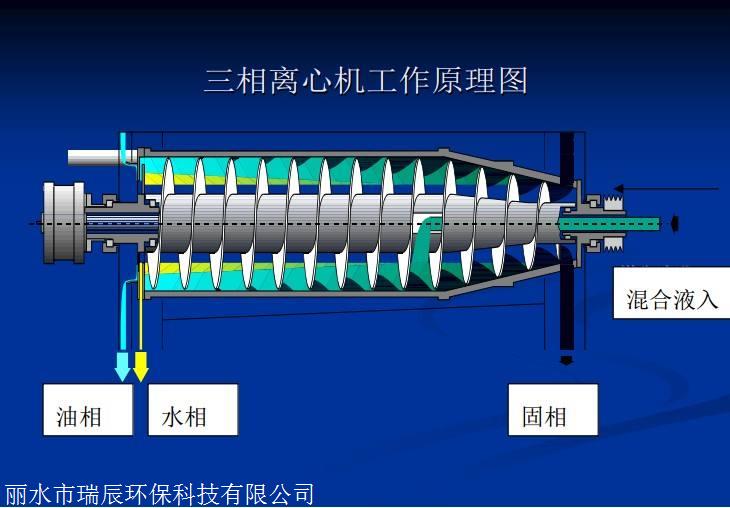
Solid liquid separation refers to the separation of a solid phase (density) from two liquid phases with different densities. The drum and screw rotate at high speed in the same direction with differential speed, and the material enters through the feeding pipe. Under the action of centrifugal force, solid phase materials deposit on the drum wall to form a sediment layer. Two types of liquid phase materials form a light liquid phase ring and a heavy liquid phase ring, respectively. Starting from the drum wall, a solid phase layer, a heavy liquid phase layer, and a light liquid phase layer are formed in sequence inward. The spiral continuously pushes the solid material deposited on the drum wall to the cone end of the drum and discharges it outside the machine through the slag discharge outlet. The light liquid phase and heavy liquid phase continuously overflow from different overflow ports at the large end of the drum. Thus achieving three-phase separation.
The working process of the three-phase horizontal screw centrifuge for oil sludge water separation equipment: The high dryness centrifuge optimizes and combines different stages of the separation process in a limited space.
Mixing and Acceleration Stage: The sludge and flocculant are mixed and accelerated in a specially designed inlet chamber to ensure that the sludge enters the separation zone in its original state.
Clarification stage: Under the action of centrifugal force, the flocculated particles quickly separate and settle in the straight section of the drum. The separated supernatant is discharged through a weir located at the end of the drum.
Compression stage: The screw propeller pushes the settled solid to the discharge end, and the sludge is further compressed under the action of centrifugal force, releasing pore water.
Bi directional squeezing stage: In the conical section of the drum, the sludge is subjected to a specially designed biaxial squeezing effect, and the screw conveyor is appropriately designed to generate squeezing force along the axial direction. Combined with the compression effect of the centrifuge, further squeeze out the capillary water of the sludge.
Control solid retention time: When the amount and quality of sludge entering the centrifuge change, continuously control the total amount of solids in the high dryness centrifuge drum to maintain the dewatering effect. This control is achieved through the drive system of the propeller. The propeller drive system can detect the total amount of solids in the drum in real time and automatically adjust the differential speed and compensate for the pushing power.
Drive technology: The reliable and excellent performance of high dryness centrifuges requires a combination of drum drive and propeller drive. Our company has developed comprehensive and complete drive combinations for all types of sludge dewatering, and can recommend suitable drive combination methods based on specific application backgrounds and requirements.
Drum drive system: optional methods include: AC motor+frequency converter; AC motor+hydraulic coupling; Other specific methods.
Spiral propeller drive system: optional methods include: AC regeneration rear drive or front wheel drive (variable frequency) DVF multi-stage planetary control; Hydraulic motor with independent hydraulic pump; Other specific methods.

AfterSalesService :
Key words:- Oil mud water separation equipment
More Products