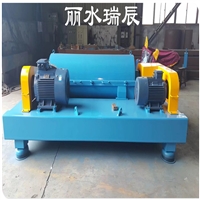
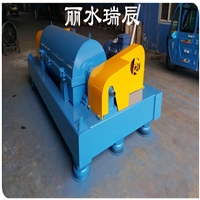
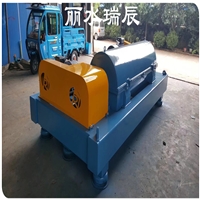
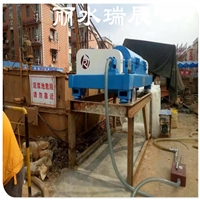
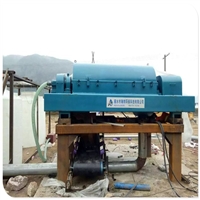
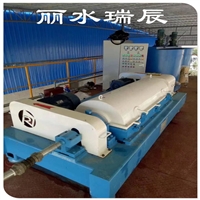
Oil sludge treatment equipment, three-phase separator, oil sludge removal and dry discharge equipment, oil cement separator
Category:
Environmental Protection/Sewage treatment equipment/Sludge treatment equipment
Model:
WL350
Brand:
Ruichen Environmental Protection
Retail Price
178,600.00USD
重量
kg
- Product Description
-
Description :
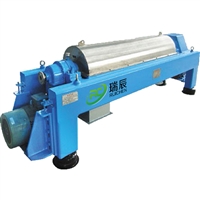
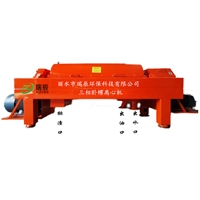
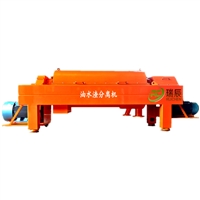
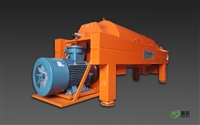
Oil sludge treatment equipment, three-phase separator, oil sludge removal and dry discharge equipment, oil cement separator
Oil and sludge treatment equipmentThree phase separator, also known as a spiral discharge settling centrifuge. It mainly consists of a high-speed drum, a screw conveyor with a hollow shaft that rotates in the same direction as the drum and has a slightly lower speed than the drum, and a differential. When the suspension to be separated is sent into the drum by the hollow shaft, it is immediately thrown into the drum cavity under the centrifugal force generated by high-speed rotation. The high-speed rotating drum generates strong centrifugal force, which throws solid particles with higher density than the liquid phase onto the inner wall of the drum, forming a solid layer (called a solid ring layer due to its ring shape); Due to its low density and centrifugal force, water can only form a liquid layer inside the solid ring layer, known as the liquid ring layer. Due to the different rotational speeds of the spiral and the drum, there is a relative motion (i.e. speed difference) between the two. The relative motion between the spiral and the drum is used to slowly push the sludge in the solid ring layer to the cone end of the drum, and after passing through the drying zone, it is continuously discharged through the outlet distributed around the circumference of the drum; The liquid in the liquid ring layer is continuously discharged from the weir mouth to the outside of the drum by gravity, forming a separated liquid.
Oil and sludge treatment equipmentThe three-phase separator has various forms of structures such as parallel flow, counter flow, composite spiral, and bi-directional extrusion. In terms of applications, it can be used for concentration, dehydration, oil removal, classification, and integrated concentration and dehydration.
Oil and sludge treatment equipmentOverview of the Separation Process of Three phase Separators:
The mixture of oil, sludge, mud and water enters the drum through the feed pipe and spiral discharge port. Under the centrifugal force generated by the high-speed rotation of the host, solid particles with a high density deposit on the inner wall of the drum. The spiral blades that move relative to the drum continuously scrape off the solid particles deposited on the inner wall of the drum and push them out of the slag discharge outlet. The separated clear liquid flows out of the drum through the opening of the weir plate. The relative motion between the spiral and the drum is achieved by a differential. The differential housing is connected to the drum, the output shaft is connected to the screw, and the input shaft is connected to the auxiliary motor. The main motor drives the rotation of the drum and also drives the rotation of the differential housing. Due to the connection between the input shaft and the auxiliary motor, the auxiliary motor generates braking torque, which drives the planetary gears to operate according to the designed transmission relationship and transmits the torque to the screw in a certain proportion, achieving continuous separation of materials in the horizontal spiral settling centrifuge.

Oil and sludge treatment equipmentAdvantages of the overall structure of the three-phase separator:
1. The design is compact, and the dewatering machine includes devices such as an electrical control cabinet, a metering tank, and a flocculation mixing tank.
2. Centrifugal dewatering machine is suitable for sludge in industries such as municipal sewage, food, beverage, chemical, leather, welding materials, papermaking, printing and dyeing, pharmaceuticals, etc.
3. Less faults, less noise and vibration, simple operation
4. The centrifugal dehydrator occupies a small space, making it easy to maintain and replace; Small weight, easy to transport, and not easily clogged.
5. It has the function of self-cleaning. No need to clean to prevent filter clogging, reduce flushing water usage, and minimize internal circulation burden.
6. Proficient in dewatering oily sludge and operating at low speeds.
7. The speed of the spiral shaft is about 2-3 revolutions per minute, with low electrode consumption.
8. The replacement parts only include the spiral shaft and the floating ring, which have a long service life.
9. Through the electric control cabinet, it is linked with the infusion machine, mud pump, dosing pump, etc. to achieve 24-hour continuous unmanned operation.
10. Short daily maintenance time, simple maintenance tasks, and long-lasting durability.
11. The body is almost entirely made of stainless steel material, which can maximize the service life of the equipment.
12. Suitable for dewatering high and low concentration sludge, low concentration (2000mg/L~) sludge dewatering does not require the construction of concentration tanks or storage tanks, reducing construction costs, phosphorus release, and anaerobic odor generation.
AfterSalesService :
Key words:- Oil and sludge treatment equipment
More Products